Unit Converter
Convert 300+ units across 12 categories: length, weight, volume, speed, area, temperature, time, and data. Metric and imperial.
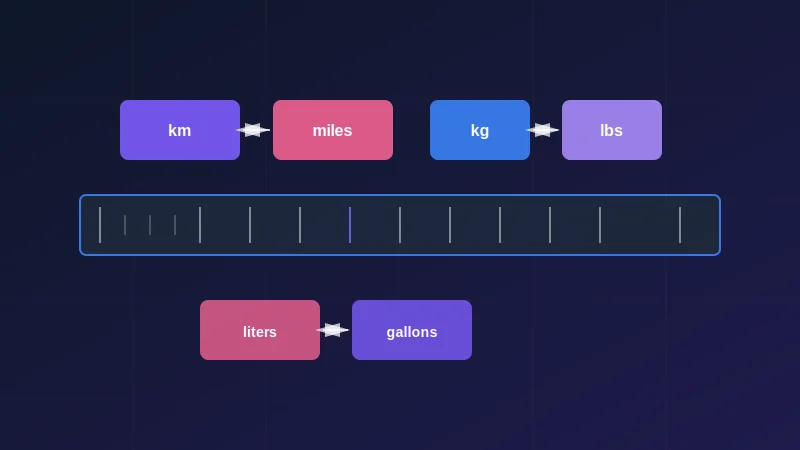
📊 Quick Length Comparisons (to cm)
📏 About the Unit Converter
Unit conversion is one of the most fundamental tasks in science, engineering, medicine, cooking, construction, and international trade. The world operates on two main measurement systems that do not naturally speak to each other: the metric system (formally called the International System of Units, or SI), used by the vast majority of countries and all scientific disciplines globally, and the US customary/imperial system, used primarily in the United States for everyday measurements. Errors in unit conversion have real consequences — NASA lost the $327 million Mars Climate Orbiter in 1999 because one engineering team used metric units and another used imperial units in the same navigation calculation. In medicine, unit confusion between micrograms and milligrams has caused fatal dosing errors. In everyday life, understanding how kilometres relate to miles, or kilograms to pounds, is essential for anyone who travels, shops internationally, or follows a recipe from another country.
This free unit converter covers 12 conversion categories and 300+ individual unit pairs, including all major metric and imperial units for length, weight, volume, speed, temperature, area, time, data storage, energy, pressure, frequency, and fuel economy. The conversion happens instantly as you type — no button to press, no page reload. A swap button lets you reverse the conversion direction in one click. The converter is fully mobile-responsive and works on any device with a browser. No account or signup is required.
Additional context — The United States remains one of only a handful of countries that has not officially adopted the metric system for everyday use, alongside Liberia and Myanmar — a fact usually attributed to the cost and disruption of converting an entire economy's infrastructure and tooling rather than any technical advantage of imperial units.
📜 History of Measurement Systems
Measurement systems are as old as civilisation itself. Ancient Egyptians used the cubit — the distance from the elbow to the tip of the middle finger — as a standard unit of length as early as 3000 BCE, and standardised cubit rods have been found in Egyptian tombs. Ancient Romans used the pace (mille passuum, or one thousand paces) as the origin of the word "mile." The problem with body-based measurements was obvious: a king's foot is not the same as a peasant's foot, and standards varied widely between towns, regions, and countries — creating constant friction in trade and construction. The first serious attempt at a universal, rational measurement system came during the French Revolution: in 1795, France introduced the metric system, defining the metre as one ten-millionth of the distance from the North Pole to the Equator along a meridian. The beauty of the metric system was its decimal base — every unit is a power of ten of the base unit — making calculations far simpler than the chaotic relationships in the imperial system (12 inches in a foot, 3 feet in a yard, 1,760 yards in a mile). The International System of Units (SI) was formally established in 1960 and has been adopted by every country in the world as the official scientific standard — including the United States, which uses SI in science, medicine, and the military even while maintaining customary units for everyday life. Today the US, Myanmar, and Liberia remain the only countries that have not fully adopted metric for everyday use, though the US is the most significant holdout by economic and population weight.
📊 Quick Reference: Most Common Unit Conversions
| Category | From | To | Exact Factor | Quick Tip |
|---|---|---|---|---|
| Length | 1 mile | km | 1.609344 km | Multiply miles by 1.6 |
| Length | 1 inch | cm | 2.54 cm | Exact by definition |
| Weight | 1 kg | lbs | 2.20462 lbs | Multiply kg by 2.2 |
| Volume | 1 US gallon | litres | 3.78541 L | UK gallon = 4.546 L |
| Temperature | °C | °F | (C × 1.8) + 32 | 100°C = 212°F |
| Speed | 100 km/h | mph | 62.137 mph | Divide km/h by 1.609 |
| Area | 1 acre | m² | 4,046.86 m² | ~0.405 hectares |
| Data | 1 GB | MB | 1,000 MB (decimal) | OS shows 1 GiB = 1,024 MiB |
🎯 Common Uses
- International Recipe Conversion: Convert cups, ounces, and tablespoons from US recipes into grams and millilitres used in metric countries, or vice versa.
- Travel and Navigation: Convert speed limits (mph to km/h), distances (miles to km), and fuel economy (mpg to L/100km) when driving in a different country.
- Engineering and Construction: Convert between imperial and metric specifications when working with materials, blueprints, or equipment sourced from different countries.
- Scientific Research and Education: Convert between SI base units and derived units for physics, chemistry, and biology calculations and lab reports.
- Medical and Pharmacy: Convert patient weight between kg and lbs for dosing calculations, and convert fluid volumes between mL, cc, fl oz, and teaspoons.
- Import and Export Documentation: Convert product dimensions and weights between the unit systems required by different countries' customs and shipping regulations.
- Fitness and Sports Tracking: Convert running distances (km to miles), body weight (kg to lbs), and lifting weights (kg to lbs) between metric and imperial fitness apps and devices.
📋 How To Use This Unit Converter
- Select a conversion category: Choose from the 12 categories at the top — Length, Weight, Volume, Speed, Temperature, Area, Time, Data Storage, Energy, Pressure, Frequency, or Fuel Economy. The unit dropdowns update automatically.
- Enter the value to convert: Type your number in the input field. Results update instantly as you type — no need to press any button.
- Choose your From unit: Select the unit you are converting from (e.g. miles, pounds, Celsius, gallons) from the left dropdown.
- Choose your To unit: Select your target unit (e.g. km, kg, Fahrenheit, litres) from the right dropdown. The converted result appears instantly.
- Use the swap button: Click the swap ⇅ button to instantly reverse the From and To units — useful for checking both directions without reselecting.
- Switch categories for a different conversion: Simply select a new category at the top and enter a new value. No page reload needed.
🔗 Related Calculators
⚠️ Common Unit Conversion Mistakes
- Confusing US and UK gallons/tons — a US gallon (3.785 L) differs from a UK/imperial gallon (4.546 L); the same applies to short tons versus long tons.
- Mixing GB and GiB in data storage — operating systems often display 1 GB as 1,024 MiB rather than the decimal 1,000 MB standard, causing apparent "missing" storage.
- Rounding too early in multi-step conversions — rounding an intermediate result before the final conversion compounds small errors into larger ones.
- Applying the wrong temperature formula — Celsius-to-Fahrenheit and Fahrenheit-to-Celsius use different formulas; mixing them up gives wildly incorrect results.
📚 References
Frequently Asked Questions
❓ How many kg in a pound?
1 pound (lb) equals exactly 0.45359237 kilograms, by international definition fixed in 1959. Conversely, 1 kilogram equals 2.20462 pounds. For a quick mental calculation, multiply pounds by 0.45 to get approximate kilograms — for example, 150 lbs is approximately 68 kg (150 × 0.45 = 67.5). The pound is used primarily in the United States and for body weight in the United Kingdom, while the kilogram is the SI base unit of mass used globally in science and most countries worldwide.
❓ How many km in a mile?
1 mile equals exactly 1.609344 kilometres, by international definition. Conversely, 1 kilometre equals 0.621371 miles. A handy rough conversion is to multiply miles by 1.6 to get kilometres, or divide kilometres by 1.6 to get miles. For example, a 5K run is 3.11 miles, and a 10-mile road trip is 16.09 km. The mile is the standard road distance unit in the US and UK, while the kilometre is used everywhere else for road signs and navigation.
❓ How many liters in a gallon?
There are two different gallons in common use. The US liquid gallon equals 3.78541 litres, while the UK imperial gallon equals 4.54609 litres — making the UK gallon about 20% larger than the US one. This is a frequent source of confusion when comparing fuel economy figures: 30 miles per US gallon equals about 25 miles per imperial gallon, and about 9.4 litres per 100 km. Always check whether a source specifies US or imperial gallons. In most non-US contexts, "gallon" without qualification usually means the imperial gallon.
❓ How many cm in an inch?
1 inch equals exactly 2.54 centimetres — a definition fixed by the International Yard and Pound Agreement of 1959. Conversely, 1 centimetre equals 0.393701 inches. Key related conversions: 1 foot (12 inches) = 30.48 cm; 1 yard (36 inches) = 91.44 cm; 6 feet = 182.88 cm. Screen sizes are always measured diagonally in inches, even in metric countries. Clothing sizes and paper dimensions (US Letter vs A4) also reflect the inch vs cm divide between the US and the rest of the world.
❓ How do you convert Celsius to Fahrenheit?
To convert Celsius to Fahrenheit, multiply by 9/5 (or 1.8) then add 32: F = (C × 1.8) + 32. For example, 100°C (boiling point of water) = (100 × 1.8) + 32 = 212°F. To reverse (Fahrenheit to Celsius): C = (F − 32) × 0.5556. Key reference points: 0°C = 32°F (water freezes), 20°C = 68°F (comfortable room temperature), 37°C = 98.6°F (normal body temperature), 100°C = 212°F (water boils at sea level). The Fahrenheit scale is used only in the United States, its territories, and a few other places; all other countries use Celsius for everyday temperature.
❓ What is the difference between metric and imperial units?
The metric system (SI) is a decimal-based system introduced in France in 1795 and formalised internationally in 1960. All units relate by powers of ten: 1 km = 1,000 m, 1 kg = 1,000 g, 1 L = 1,000 mL. This makes arithmetic and unit conversion straightforward. The imperial/US customary system uses historically derived, non-decimal relationships: 1 mile = 5,280 feet = 1,760 yards; 1 gallon = 4 quarts = 8 pints = 128 fl oz. The metric system is the global standard for science, medicine, and international trade, and is the official system of every country except the United States, Myanmar, and Liberia for everyday use.
❓ How many MB in a GB?
1 gigabyte (GB) equals 1,000 megabytes (MB) in the decimal (SI) system used by hard drive manufacturers, internet providers, and most consumer storage specifications. However, in the binary system used internally by operating systems and RAM, 1 gibibyte (GiB) equals 1,024 mebibytes (MiB). This discrepancy explains why a 1 TB hard drive shows as approximately 931 GB in Windows or macOS: the manufacturer counts in decimal (1 TB = 10¹² bytes) while the OS reports in binary (1 GB = 2³⁰ bytes). For everyday file management and storage planning, the decimal definition (1 GB = 1,000 MB) is what you will see on packaging, spec sheets, and pricing.
❓ How many metres per second is 100 km/h?
100 km/h equals exactly 27.778 metres per second (m/s). To convert any km/h value to m/s, divide by 3.6. This is because 1 km/h = 1,000 metres per 3,600 seconds = 1 ÷ 3.6 m/s. To convert back, multiply m/s by 3.6. In miles per hour, 100 km/h equals 62.137 mph. Speed unit knowledge is important across contexts: aircraft speeds are quoted in knots (1 knot = 1.852 km/h), physics problems use m/s as the SI standard, road signs use km/h or mph depending on country, and athletics use both km/h and m/s for sprint analysis.