Fraction Calculator
Add, subtract, multiply, and divide fractions instantly. Handles mixed numbers, simplifies results automatically, and shows step-by-step working. Perfect for students and professionals.
📊 Common Fractions as Decimals
📖 About Fraction Calculator
A fraction calculator performs arithmetic on fractions — numbers expressed as one integer divided by another (numerator ÷ denominator). Unlike whole number arithmetic, fractions require finding common denominators for addition and subtraction, and applying the keep-change-flip rule for division. Our calculator handles all of this automatically, showing results in simplified form, as decimals, and as mixed numbers simultaneously.
Our free fraction calculator supports addition, subtraction, multiplication, and division of any two fractions including mixed numbers and negative fractions. It also shows the GCD (Greatest Common Divisor) used for simplification and the LCD (Least Common Denominator) for addition and subtraction. No signup required — works on all devices.
Additional context — Ancient Egyptian mathematics relied almost exclusively on unit fractions — fractions with a numerator of 1, like 1/3 or 1/7 — and expressed more complex fractions as sums of these, a system that made certain calculations far more cumbersome than the fraction notation standardized centuries later and used today.
📜 History of Fractions
Fractions are one of the oldest mathematical concepts, with evidence of fractional notation dating back to ancient Egypt around 1650 BCE in the Rhind Mathematical Papyrus — the oldest surviving mathematical document. Ancient Egyptians used only unit fractions (fractions with numerator 1, like 1/2, 1/3, 1/4) and expressed other fractions as sums of these. For example, 2/5 was written as 1/3 + 1/15. Ancient Babylon used a base-60 system which naturally produced fractions. The modern notation of a numerator over a denominator separated by a horizontal bar (the vinculum) was introduced by Arabic mathematician al-Hassar around 1175 CE and adopted in Europe through Fibonacci's Liber Abaci in 1202. This notation has remained the standard for over 800 years.
📐 Fraction Operations — Quick Reference
- Addition: Find LCD, convert fractions, add numerators — e.g. 1/3 + 1/4 = 4/12 + 3/12 = 7/12
- Subtraction: Find LCD, convert fractions, subtract numerators — e.g. 3/4 − 1/3 = 9/12 − 4/12 = 5/12
- Multiplication: Multiply numerators × numerators, denominators × denominators — e.g. 2/3 × 3/4 = 6/12 = 1/2
- Division: Keep first, change to ×, flip second (reciprocal) — e.g. 2/3 ÷ 4/5 = 2/3 × 5/4 = 10/12 = 5/6
- Simplification: Divide both numerator and denominator by their GCD
- Mixed to Improper: (Whole × Denominator + Numerator) / Denominator — e.g. 2¾ = 11/4
🎯 Common Uses
- School maths homework — fraction arithmetic for primary and secondary levels
- Cooking and recipes — scaling fractions up or down for different serving sizes
- Construction and carpentry — measuring in fractions of inches or feet
- Financial calculations — interest rates and proportional splits
- Science and engineering — ratios, proportions, and measurement conversions
- Music theory — note values and time signatures are fraction-based
- Exam preparation — SAT, GCSE, A-level fraction practice
🧭 How to Use This Calculator
- Enter first fraction — type numerator and denominator
- Select operation — add, subtract, multiply, or divide
- Enter second fraction — type numerator and denominator
- Click Calculate — result appears instantly
- Read results — simplified fraction, decimal, mixed number, GCD and LCD
⚠️ Common Mistakes
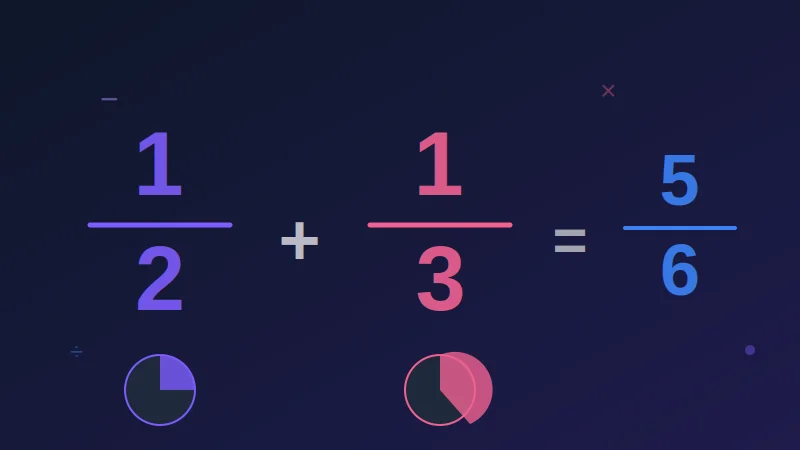
- Adding fractions without a common denominator — 1/2 + 1/3 is not 2/5; both fractions must share a denominator before adding numerators.
- Forgetting to simplify the final answer — 4/8 and 1/2 are equal, but most contexts (exams, recipes) expect the fraction in lowest terms.
- Mixing up fraction division — dividing by a fraction means multiplying by its reciprocal; a common source of sign and value errors.
🔗 Related Calculators
Frequently Asked Questions
❓ How do you add fractions with different denominators?
Find the LCD (Least Common Denominator), convert each fraction, then add numerators. Example: 1/3 + 1/4. LCD = 12. Convert: 4/12 + 3/12 = 7/12. Our calculator finds the LCD automatically and shows the full step-by-step working for every addition.
❓ How do you multiply fractions?
Multiply numerators together and denominators together, then simplify. Example: 2/3 × 3/4 = (2×3)/(3×4) = 6/12 = 1/2. Unlike addition, you do not need a common denominator for multiplication — just multiply straight across and simplify the result.
❓ How do you divide fractions?
Keep the first fraction, change division to multiplication, flip the second fraction (reciprocal). Example: 2/3 ÷ 4/5 = 2/3 × 5/4 = 10/12 = 5/6. The phrase "keep-change-flip" or "invert and multiply" helps remember this rule. Enter both fractions and select divide in our calculator for instant results.
❓ What is an improper fraction?
An improper fraction has a numerator larger than its denominator — such as 7/4 or 11/3 — representing a value greater than 1. Improper fractions can be converted to mixed numbers: 7/4 = 1 and 3/4. Our calculator accepts improper fractions as inputs and shows results as both improper fractions and mixed numbers.
❓ How do I simplify a fraction?
Find the GCD (Greatest Common Divisor) of numerator and denominator, then divide both by it. Example: simplify 12/18. GCD = 6. 12÷6 = 2, 18÷6 = 3. Result: 2/3. Our calculator automatically simplifies all results to their lowest terms and displays the GCD used for full transparency.
❓ What is LCD in fractions?
LCD (Least Common Denominator) is the smallest number that both denominators divide into evenly — needed for adding or subtracting fractions. Example: for denominators 4 and 6, LCD = 12. Our calculator shows the LCD for every addition and subtraction to help you understand the working.
❓ What is the difference between GCD and LCM?
GCD (Greatest Common Divisor) is the largest number dividing evenly into two numbers — used to simplify fractions. Example: GCD(12,18) = 6. LCM (Least Common Multiple) is the smallest number both divide into evenly — used as LCD for adding fractions. Example: LCM(4,6) = 12. Our calculator displays both for every calculation.
❓ How do you convert a fraction to a decimal?
Divide the numerator by the denominator. Example: 3/4 = 3 ÷ 4 = 0.75. Some fractions produce repeating decimals: 1/3 = 0.333... and 2/7 = 0.285714... Our calculator automatically shows the decimal equivalent for every fraction result, displayed to 6 decimal places for accuracy.