Sleep Calculator
Find the best times to go to sleep or wake up based on 90-minute sleep cycles. Wake up feeling refreshed by timing your sleep to complete full cycles. Science-backed and free.
⚠️ Health disclaimer: Sleep cycle timing here is an average estimate based on 90-minute cycles — actual cycle length varies night to night and person to person. If you're dealing with ongoing insomnia, sleep apnea symptoms, or chronic fatigue, this isn't a substitute for seeing a sleep specialist or your doctor.
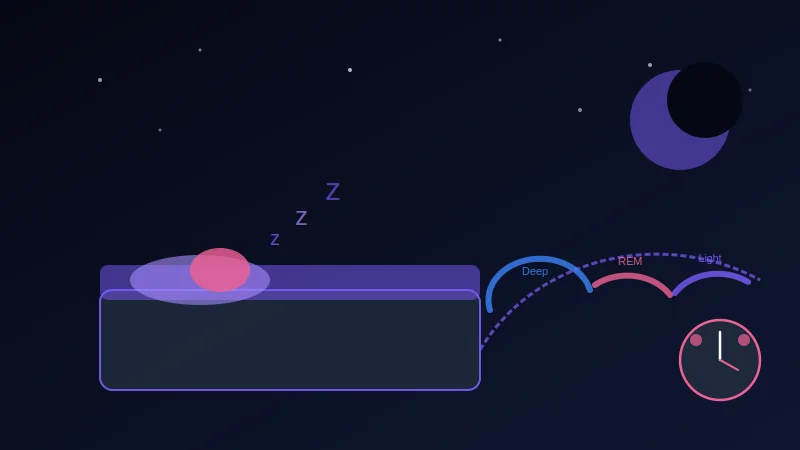
📊 Visual Guide — Five 90-Minute Sleep Cycles
About This Tool
📖 About the Sleep Calculator
The Sleep Calculator uses the science of 90-minute sleep cycles to calculate the precise times you should wake up or go to bed — so you consistently wake at the lightest, easiest point in your sleep cycle rather than being jolted out of deep sleep by an alarm. Human sleep is not a single uniform state: it cycles through four distinct stages (N1 light sleep → N2 stable sleep → N3 deep slow-wave sleep → REM rapid eye movement sleep), and waking during N3 or early in a cycle causes sleep inertia — the intense grogginess that can linger for 30–60 minutes. By timing your alarm to the natural end of a cycle, you wake during the light N1/N2 stage, feeling alert within minutes.
APluscalc's sleep calculator works in two directions: enter your bedtime to see the best times to set your alarm, or enter the time you must wake up to see the ideal bedtimes that complete 4, 5, or 6 full cycles. You can also adjust the sleep onset latency — the time it takes you to fall asleep after lying down — so every calculation is personalised to your actual sleep pattern, not a one-size-fits-all estimate. No account, no signup, no app required — it runs instantly in your browser.
Worth noting — Sleep researchers distinguish between chronotype — a person's natural tendency toward earlier or later sleep timing — and total sleep need itself. Two people who both complete five full 90-minute cycles can still have very different optimal bedtimes depending on whether they are naturally an early or late type, a factor this calculator does not measure directly.
Background & History
📜 History of Sleep Science & Cycle Research
Humans have understood the importance of sleep since antiquity, but the scientific study of sleep architecture began in the 20th century. In 1929, German psychiatrist Hans Berger invented the electroencephalogram (EEG), which for the first time allowed researchers to measure electrical brain activity during sleep. Early EEG studies revealed that sleep was not a passive, uniform state — brain activity changed dramatically throughout the night. The landmark discovery came in 1953 when physiologist Nathaniel Kleitman and his graduate student Eugene Aserinsky at the University of Chicago identified REM (Rapid Eye Movement) sleep — characterised by rapid eye movements, vivid dreaming, and near-waking brain activity — fundamentally changing our understanding of sleep. Kleitman subsequently proposed the Basic Rest-Activity Cycle (BRAC), noting that the roughly 90-minute oscillation observed in sleep also appears during waking hours. In 1957, Kleitman and William Dement published the first description of the complete sleep stage cycle (NREM and REM alternation), laying the foundation for modern sleep medicine. The 1968 standardisation by Rechtschaffen and Kales established the sleep stage classification still used today (updated in 2007 by the American Academy of Sleep Medicine to the current N1/N2/N3/REM model). Research in the 1980s and 1990s quantified the cognitive consequences of sleep deprivation — studies at the University of Pennsylvania demonstrated that sleeping 6 hours nightly for two weeks produced impairment equivalent to 48 hours of total sleep deprivation. The National Sleep Foundation published its landmark sleep duration recommendations in 2015, and a 2021 European Heart Journal study of 88,000 adults identified the 10:00–11:00 PM sleep onset window as associated with the lowest cardiovascular disease risk. Today, consumer sleep trackers, smartwatches, and tools like this calculator bring decades of sleep science research into everyday practice.
🌙 Sleep Stages — What Happens Each Night
| Stage | Duration | Brain Activity | Key Function |
|---|---|---|---|
| N1 — Light Sleep | 1–5 min | Theta waves | Transition from wakefulness; easily woken |
| N2 — Stable Sleep | 10–25 min | Sleep spindles, K-complexes | Body temp drops, heart rate slows; memory encoding |
| N3 — Deep Sleep | 20–40 min | Delta waves (slow-wave) | Physical restoration, immune function, growth hormone release |
| REM Sleep | 10–60 min* | Near-waking (mixed freq) | Dreaming, memory consolidation, emotional processing, creativity |
* REM duration increases with each successive cycle — the final REM period before waking can last 45–60 minutes. Source: AASM sleep staging guidelines.
🎯 Common Uses
- Daily Alarm Setting — Calculate cycle-aligned wake times every night so you consistently wake feeling alert rather than dragged out of deep sleep.
- Shift Workers & Irregular Schedules — Find the best sleep window when your work hours change, ensuring you still complete the maximum number of full cycles available.
- Students During Exam Season — Balance late-night study sessions with cycle-optimised sleep to preserve memory consolidation and cognitive performance.
- New Parents — Plan nap and sleep windows around a baby's schedule to maximise recovery from fragmented nighttime sleep.
- Travel & Jet Lag Recovery — Calculate new local bedtimes after crossing time zones to realign your circadian rhythm as quickly as possible.
- Nap Planning — Schedule a 90-minute afternoon nap (one full cycle) or a 20-minute power nap (N1/N2 only, no grogginess) strategically around work or study.
- Sleep Debt Awareness — Understand how many cycles you need versus how many you're getting, and plan recovery sleep over a weekend or rest day.
📋 How To Use the Sleep Calculator
- Choose your mode — Select "I want to wake up at…" to find the best bedtimes, or "I want to go to sleep at…" to find the best wake-up times. Both modes use the same 90-minute cycle model.
- Enter your time — Input your planned bedtime or required wake-up time using the time picker. Be precise — even 15-minute differences shift your cycle windows noticeably.
- Adjust sleep onset latency — The calculator defaults to 14 minutes (population average time to fall asleep). If you fall asleep in 5 minutes or take 30 minutes, update this field for more accurate results.
- Review your options — The tool displays 4–6 times, each aligned to the end of a complete sleep cycle (4 cycles = 6 hrs, 5 cycles = 7.5 hrs, 6 cycles = 9 hrs). Each option shows the cycle count and total sleep time.
- Pick the most practical time — Choose the time that gives you the most complete cycles while fitting your schedule. Prioritise 5 or 6 cycles (7.5–9 hours) whenever possible.
- Maintain a consistent schedule — The greatest long-term benefit comes from keeping the same sleep and wake times every day, training your circadian rhythm to match your chosen cycle times naturally.
🧒 Sleep Cycles and Needs by Age
Sleep architecture changes significantly across a lifetime. Newborns and infants need 12–16 hours in short cycles of around 50–60 minutes. School-age children need 9–11 hours with cycles lengthening toward the adult 90-minute pattern. Adults typically need 7–9 hours across 4–6 full 90-minute cycles per night. Older adults (65+) often need a similar total but experience lighter, more fragmented sleep with less deep (slow-wave) sleep — which is why afternoon naps become more common with age.
😴 The Real Cost of Sleep Debt
Sleep debt accumulates: losing just 1–2 hours of sleep per night for a week produces cognitive impairment comparable to a full night of no sleep, according to sleep research. Effects include slower reaction time, reduced memory consolidation, impaired glucose metabolism, and measurable mood changes. Unlike financial debt, sleep debt cannot be fully "repaid" by one long weekend lie-in — consistent nightly sleep restores function far better than occasional catch-up sleep.
⚠️ Common Sleep Timing Mistakes
- Setting an alarm mid-cycle — waking in the middle of a 90-minute cycle (during deep sleep) causes grogginess (sleep inertia), even after adequate total sleep time.
- Inconsistent sleep and wake times — irregular schedules disrupt the body's circadian rhythm more than a slightly shorter but consistent sleep window.
- Screen use right before bed — blue light exposure suppresses melatonin production and can delay sleep onset by 30+ minutes.
- Relying on weekend "catch-up" sleep — this can actually worsen Monday alertness by shifting your circadian rhythm, an effect researchers call "social jet lag."
🔗 Related Calculators
View all Health Calculators →Frequently Asked Questions
❓ What is a sleep cycle?
A sleep cycle lasts approximately 90 minutes and consists of four distinct stages: N1 (light sleep — the brief transition from wakefulness, lasting 1–5 minutes), N2 (stable sleep — heart rate slows, body temperature drops, sleep spindles appear; 10–25 minutes), N3 (deep slow-wave sleep — the most physically restorative stage, with delta brain waves; 20–40 minutes), and REM (Rapid Eye Movement — vivid dreaming and memory consolidation; grows longer with each cycle). Adults typically complete 4–6 full cycles per night, totalling 6–9 hours. Early cycles are dominated by N3 deep sleep; later cycles are dominated by REM. This is why the last few hours of a full night's sleep are so cognitively valuable — cutting them short disproportionately reduces REM.
❓ How many hours of sleep do I need?
According to the CDC and National Sleep Foundation, adults aged 18–64 need 7–9 hours per night. Teenagers (13–18) need 8–10 hours. School-age children (6–12) need 9–12 hours. Toddlers (1–2 years) need 11–14 hours. Infants (4–11 months) need 12–15 hours. Seniors (65+) need 7–8 hours. In cycle terms, most adults feel best after completing 5 full cycles (7.5 hours) or 6 full cycles (9 hours). A reliable personal test: if you wake without an alarm feeling genuinely rested and stay alert through the day without caffeine, you are meeting your individual sleep need.
❓ Why do I wake up tired even after 8 hours?
Waking during N3 deep sleep — the middle of a cycle — causes sleep inertia: the intense grogginess, confusion, and impaired performance that can persist for 15–60 minutes. Eight hours of sleep does not automatically align with cycle boundaries. For example: if you fall asleep at midnight (with 14 minutes of onset latency, actually asleep at 12:14 AM), your cycles end at 1:44, 3:14, 4:44, 6:14, 7:44, and 9:14 AM. An 8:00 AM alarm cuts 16 minutes into your sixth cycle — deep N3 sleep. A 7:44 AM alarm gives you 16 fewer minutes of sleep but wakes you at the end of cycle five, leaving you feeling dramatically more alert. This calculator solves this problem precisely.
❓ What is REM sleep and why is it important?
REM (Rapid Eye Movement) sleep is the stage most associated with vivid dreaming, named for the characteristic rapid movements of the eyes under closed eyelids. It occurs primarily in the second half of each sleep cycle and grows progressively longer — the final REM period of a full night can last 45–60 minutes. REM sleep is critical for memory consolidation (converting experiences from short-term to long-term memory), emotional regulation (processing difficult emotions and reducing their intensity), creativity and problem-solving, and learning. Research published in Nature and Science has shown that even partial REM deprivation — caused by cutting the last 1–2 hours of sleep — significantly impairs all of these functions. This is why sleeping 6 hours instead of 8 is far more cognitively costly than the numbers suggest.
❓ What time should I go to sleep?
The best bedtime depends on your required wake-up time and how many cycles you want to complete. For a 6:00 AM wake-up: 5 cycles (7.5 hrs) → go to bed at 10:16 PM; 6 cycles (9 hrs) → go to bed at 8:46 PM. For a 7:00 AM wake-up: 5 cycles → go to bed at 11:16 PM; 6 cycles → go to bed at 9:46 PM. All times account for the 14-minute average sleep onset latency. Research from the European Heart Journal (2021, study of 88,000 adults) found that people who fell asleep between 10:00–11:00 PM had the lowest risk of cardiovascular disease — but completing full cycles matters more than the absolute clock time. Use the calculator above to get your precise, personalised recommendations.
❓ What is sleep debt?
Sleep debt is the cumulative shortfall between the sleep your body needs and the sleep you actually get. It builds incrementally — sleeping 6 hours when you need 8 adds 2 hours of debt per night, reaching the equivalent of a full lost night after just four days. Research from the University of Pennsylvania found that after two weeks of sleeping only 6 hours per night, subjects' cognitive performance declined to the level seen after 48 hours of total sleep deprivation — yet most rated themselves as only "slightly sleepy," dramatically underestimating their impairment. Chronic sleep debt is associated with increased risk of obesity, type 2 diabetes, cardiovascular disease, impaired immunity, depression, and reduced life expectancy. Some sleep debt can be partially recovered with extended sleep over subsequent nights, but recovery is not 1-for-1 and takes longer than the debt was accumulated.
❓ Can naps replace missed nighttime sleep?
Short naps are effective supplements but cannot fully replace lost nighttime sleep. A 10–20 minute power nap (N1/N2 only) improves alertness, mood, reaction time, and short-term memory without causing sleep inertia — NASA research found a 26-minute nap improved pilot performance by 34% and alertness by 100%. A 90-minute nap completes one full sleep cycle including N3 and REM and provides deeper restoration. However, naps compress the complex architecture of full sleep — particularly the progressive lengthening of REM across multiple cycles — so they supplement rather than replace nighttime sleep. Avoid napping after 3 PM as it can delay your natural sleep onset at night, compounding rather than solving your sleep debt.
❓ What is sleep onset latency and why does it matter?
Sleep onset latency (SOL) is the time between lying down and actually falling asleep. The population average is 10–20 minutes. Consistently falling asleep in under 5 minutes is a clinical sign of significant sleep deprivation — your body is so exhausted it transitions to sleep almost immediately. Regularly taking over 30 minutes to fall asleep may indicate insomnia, excessive pre-bed screen exposure (blue light suppresses melatonin), high caffeine intake, or anxiety. SOL matters for this calculator because your 90-minute cycles start from the moment you actually fall asleep, not when you get into bed. If your SOL is 25 minutes and you use a default of 14 minutes, every cycle time shown will be 11 minutes off. Adjusting the SOL input to match your reality gives you far more accurate, useful results.