Area & Volume Calculator
Calculate area, perimeter, volume, and surface area for rectangles, circles, triangles, spheres, cylinders, and more.
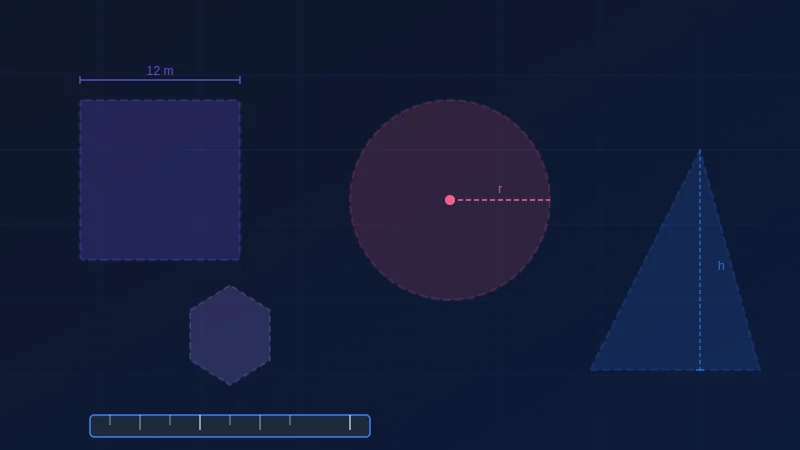
📊 How Big Is an Acre? Area Comparisons
📖 About Area & Volume Calculator
Geometric calculations are fundamental to architecture, construction, manufacturing, landscaping, interior design, and everyday home improvement. Whether calculating paint coverage for walls, concrete for a foundation, water volume for a swimming pool, fabric for a sewing project, or flooring tiles for a room — accurate area and volume calculations prevent costly material waste and measurement errors.
Our free area and volume calculator supports 15+ shapes including rectangle, square, circle, triangle, trapezoid, parallelogram, ellipse, sector, sphere, cylinder, cone, and cube. It calculates area, perimeter, and volume simultaneously with support for all common units — mm, cm, m, inches, feet, and yards. No signup required, works on all devices.
Additional context — The acre predates the metric system by centuries — it was originally defined as the area a yoke of oxen could plough in a single day, which is why its modern conversion (4,840 square yards) looks like an oddly specific number rather than a round one.
📜 History of Geometry
Geometry — from the Greek words "geo" (earth) and "metria" (measurement) — was originally developed to measure land after the annual Nile floods in ancient Egypt erased boundary markers. Around 3000 BCE, Egyptian surveyors called "rope stretchers" used knotted ropes to re-establish field boundaries and calculate areas for taxation. The ancient Babylonians independently discovered accurate area formulas around 2000 BCE. Euclid of Alexandria systematized geometry in his landmark work "Elements" around 300 BCE, establishing the logical proofs for area and volume formulas still taught in schools today. Archimedes later calculated the precise formula for sphere volume and surface area. The development of calculus by Newton and Leibniz in the 17th century enabled the calculation of areas and volumes of irregular shapes — the foundation of modern engineering and architecture.
📐 Key Area & Volume Formulas
- Rectangle: Area = length × width | Perimeter = 2(l + w)
- Circle: Area = π × r² | Circumference = 2 × π × r
- Triangle: Area = ½ × base × height
- Cylinder: Volume = π × r² × h | Surface = 2πr(r + h)
- Sphere: Volume = (4/3) × π × r³ | Surface = 4 × π × r²
- Cone: Volume = (1/3) × π × r² × h
- Cube: Volume = side³ | Surface = 6 × side²
🎯 Common Uses
- Home painting — calculate wall area to buy the right amount of paint
- Flooring and tiling — find room area to order correct number of tiles
- Gardening and landscaping — calculate lawn, garden bed, or paving area
- Construction and concrete — volume of foundations, slabs, and columns
- Swimming pool volume — water capacity for chemicals and heating cost
- Fabric and sewing projects — calculate material needed for patterns
- Academic maths — homework, exam practice, and geometry coursework
🧭 How to Use This Calculator
- Select your shape — rectangle, circle, triangle, cylinder, sphere etc.
- Enter dimensions — length, width, radius, height as required
- Select your unit — mm, cm, m, inches, feet, or yards
- Read instant results — area, perimeter, and volume appear automatically
- Use for your project — copy result to plan materials and quantities
⚠️ Common Mistakes
- Mixing units mid-calculation — measuring length in feet and width in metres without converting first gives a meaningless result.
- Confusing perimeter with area — perimeter measures the boundary length; area measures the enclosed surface — different formulas entirely.
- Rounding intermediate steps too early — for irregular shapes broken into simpler ones, round only the final total, not each sub-area.
📚 References
🔗 Related Calculators
Frequently Asked Questions
❓ How do you find the area of a circle?
Area of a circle = π × r² (pi multiplied by radius squared). Example: a circle with radius 5cm has area = 3.14159 × 5 × 5 = 78.54 cm². If you know the diameter, the radius = diameter ÷ 2. The circumference = 2 × π × r = 31.42 cm for the same circle. Enter the radius in our calculator and both area and circumference appear instantly.
❓ How do you calculate the volume of a cylinder?
Volume of a cylinder = π × r² × h (pi × radius squared × height). Example: a cylinder with radius 3cm and height 10cm has volume = 3.14159 × 9 × 10 = 282.74 cm³ (approximately 282.74 ml). This formula is used for water tanks, pipes, cans, pools, and any cylindrical container. Enter radius and height in our calculator for instant results.
❓ What is the area of a triangle?
Area of a triangle = ½ × base × height. Example: a triangle with base 8cm and height 6cm has area = 0.5 × 8 × 6 = 24 cm². If you know all three sides but not the height, use Heron's formula: Area = √(s(s−a)(s−b)(s−c)) where s = (a+b+c) ÷ 2. Our calculator supports both methods — enter what you know and get the area instantly.
❓ How do I calculate square footage?
Measure length and width in feet and multiply: Area = length × width. Example: a room 12 feet long and 10 feet wide = 120 square feet. For irregular rooms, divide into rectangles, calculate each separately, and add them. Select "feet" as your unit in our calculator for results directly in square feet — useful for flooring, carpet, and paint calculations.
❓ How do you calculate the area of a rectangle?
Area = length × width. Example: 8m × 5m = 40 m². Perimeter = 2 × (length + width) = 2 × (8 + 5) = 26m. Used for floor area, wall area for painting, garden beds, and any rectangular material quantity. Enter your length and width in our calculator and both area and perimeter appear simultaneously.
❓ How much paint do I need for a room?
Calculate total wall area (each wall: length × height), subtract doors (~2 m² each) and windows (~1.5 m² each). One litre of standard paint covers approximately 10–12 m² per coat. Divide total area by 11 to find litres per coat and double for two coats. Example: 40 m² of walls needs approximately 40 ÷ 11 × 2 = 7.3 litres for two coats. Use our rectangle calculator for each wall.
❓ How do you calculate the volume of a sphere?
Volume = (4/3) × π × r³. Example: a sphere with radius 4cm has volume = 4/3 × 3.14159 × 64 = 268.08 cm³. Surface area = 4 × π × r² = 201.06 cm². Sphere calculations are used for ball bearings, water tanks, domes, sports balls, and any spherical container. Enter radius in our calculator for instant volume and surface area.
❓ What is the difference between area and volume?
Area measures a 2D flat surface — expressed in square units (cm², m², ft²). Volume measures 3D space inside an object — expressed in cubic units (cm³, m³, ft³). Example: a room's floor has area (how much flooring you need), while a swimming pool has volume (how much water it holds). Always identify whether you need area or volume before starting your calculation to avoid measuring errors.