Random Number Generator
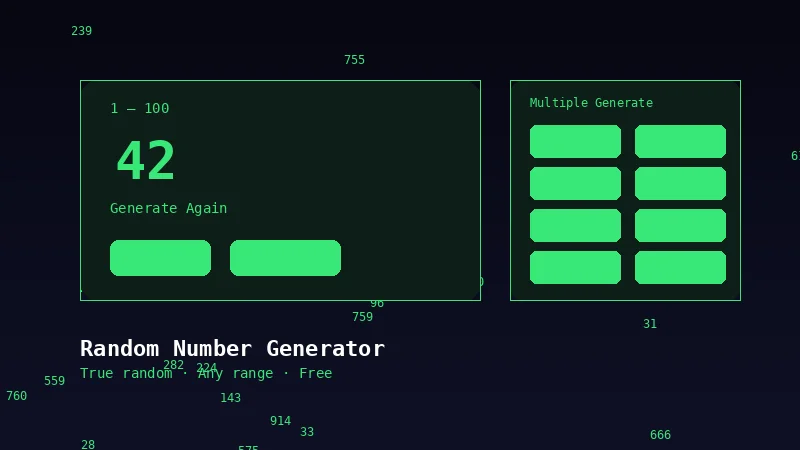
Generate truly random numbers in any range — single or multiple at once. Cryptographically secure, with no-repeat mode, quick presets, and full history log. Free, no signup needed.
📊 Common Random Number Ranges
About This Tool
📖 About the Random Number Generator
A random number generator (RNG) produces numbers that cannot be predicted by any pattern or algorithm. APluscalc's free online RNG uses the browser's built-in crypto.getRandomValues() API — a cryptographically secure pseudorandom number generator (CSPRNG). This is the same technology used in password managers, cryptographic key generation, and security-sensitive applications, making it far more reliable than the basic Math.random() function used by many other online tools.
All number generation runs entirely inside your browser — nothing is sent to any server, so your lottery picks, game rolls, and random decisions remain completely private. The tool works offline once the page loads. With support for custom ranges, no-repeat mode, quick presets, and a full history log, this is the most capable free random number picker available — no signup, no ads interfering with results, and no limits on how many times you generate.
Additional context — True hardware random number generators, unlike the pseudorandom algorithms most software relies on, often draw entropy from physical noise sources such as atmospheric static or the thermal noise inside a computer's own circuitry — sources chosen specifically because they can't be predicted or reverse-engineered.
Background & History
📜 History of Random Number Generation
Random number generation has been fundamental to science, mathematics, and computing since antiquity. The earliest RNGs were physical devices — dice made from sheep ankle bones (astragali) have been found at archaeological sites in Mesopotamia dating to around 3000 BCE, and were used for games of chance, divination, and decision-making. Roulette wheels, shuffled card decks, and lottery drums served as physical RNGs for centuries. The formalization of randomness as a mathematical concept began in the early 20th century: in 1927, statistician L.H.C. Tippett published the first table of 41,600 random digits compiled from census records, used by researchers for statistical sampling. In 1946, mathematician John von Neumann proposed the middle-square method — the first algorithmic PRNG — which generated numbers by squaring the current value and extracting the middle digits. The 1949 RAND Corporation publication "A Million Random Digits with 100,000 Normal Deviates" became a landmark reference, distributed on punched cards and used in research for decades. The Linear Congruential Generator (LCG), introduced by Lehmer in 1948, became widely adopted in programming languages. The Mersenne Twister algorithm, published by Matsumoto and Nishimura in 1998, brought a period of 2^19937−1 and became the gold standard for general-purpose PRNGs, forming the basis for Python's random module and many others. Cryptographically secure RNGs became essential with the rise of internet security in the 1990s — the SSL/TLS protocol (1995) required secure random key generation, and standards like FIPS 140-2 and NIST SP 800-90A were developed to certify CSPRNG implementations. Today, every modern browser exposes crypto.getRandomValues(), seeded from hardware entropy sources, as the recommended standard for any application requiring unpredictable random numbers — from lottery pickers to cryptographic key generators.
🔬 PRNG vs CSPRNG vs TRNG — Comparison
| Feature | PRNG (Math.random) |
CSPRNG (crypto.getRandomValues) |
TRNG (hardware/atmospheric) |
|---|---|---|---|
| Predictable? | Yes (with seed) | No | No |
| Speed | Very fast | Fast | Slow |
| Suitable for security? | No | Yes | Yes |
| Reproducible with seed? | Yes | No | No |
| Entropy source | Algorithm seed | Hardware events | Physical phenomena |
| Used by APluscalc? | No | ✓ Yes | N/A (browser) |
🎯 Common Uses
- Lottery & Raffle Picks — Generate unique, unbiased number sets for 6/49, Powerball, or any lottery format using the no-repeat mode.
- Board Games & Tabletop RPGs — Replace physical dice for any sided-die (d4, d6, d8, d10, d12, d20) or use custom ranges for RPG stat rolls.
- Random Group Selection — Pick a random winner, decide who goes first, or assign people to teams fairly without bias.
- Statistical Sampling & Research — Generate random indices or values for survey sampling, Monte Carlo simulations, and probability experiments.
- Classroom Activities — Randomly select students to answer questions, form groups, or assign topics equitably.
- A/B Testing & Experiments — Randomly assign user IDs or session numbers to test and control groups for web experiments.
- Password & PIN Seed Values — Generate random base numbers to seed password creation or create memorable PINs with built-in randomness. Also see our Password Generator.
📋 How To Use the Random Number Generator
- Select a preset or enter a custom range — Click a preset button (Dice 1–6, 1–10, 1–100, Lottery 6/49, 1–1000, Byte 0–255) for instant setup, or type your own Min and Max values into the input fields.
- Set the quantity — Enter how many numbers you want in the Quantity field (1–100). Leave at 1 for a single pick, or increase for lottery-style sets.
- Enable No-Repeat mode if needed — Check the "No repeats" checkbox to guarantee all generated numbers are unique. Required for lottery draws and raffle picks. The generator will alert you if your quantity exceeds the range size.
- Click Generate or tap the display — Press the "🎲 Generate Random Number" button or tap the large display area. Your cryptographically secure result appears instantly. Multiple numbers appear as individual chips.
- Review the history log — Every result is logged with its range and timestamp in the history panel. Regenerate as many times as you like — there are no limits.
- Clear and start fresh — Click "Clear History" to reset the log, or simply change your range and generate again for a new session.
🔒 Is It Really Random?
The crypto.getRandomValues() API draws from the operating system's entropy pool, which is seeded by physical hardware events — keystrokes, mouse movements, CPU timing jitter, and hardware noise. This makes it practically unpredictable and suitable for security-sensitive applications. For almost all practical purposes (games, decisions, simulations, statistical work), this is as random as you can get in a browser — indistinguishable from a hardware TRNG. Also see our Dice Roller for physical dice simulation, or our Password Generator for cryptographically secure password creation.
⚠️ Common Mistakes
- Assuming "true" randomness — most software random number generators are pseudorandom (algorithmically generated); for cryptographic security, a dedicated CSPRNG is required, not a general-purpose generator.
- Reading patterns into short sequences — humans naturally see patterns in randomness; a truly random sequence can still contain repeated numbers or streaks.
- Using the same seed range for unrelated draws — for fair raffles or lotteries, make sure the number range and exclusion of duplicates match the actual rules.
🔗 Related Calculators
Frequently Asked Questions
❓ Is this random number generator truly random?
Yes. APluscalc uses the browser's crypto.getRandomValues() API, which generates cryptographically secure random numbers seeded from hardware entropy — including keystrokes, mouse movements, and CPU timing jitter. This is far superior to Math.random(), which uses a predictable pseudorandom algorithm that can theoretically be reverse-engineered by an attacker who has observed enough outputs. For games, decisions, lottery picks, and any application requiring unpredictable numbers, APluscalc's approach is the gold standard available in modern browsers.
❓ Can I generate random numbers without repeating?
Yes. Enable the "No Repeats" checkbox before clicking Generate. The tool will ensure every number in your generated set is unique — no duplicates. This is perfect for lottery simulations, raffle draws, and selecting unique items from a numbered list. If you request more unique numbers than your range contains (for example, 10 unique numbers from a range of 1–5 which only has 5 values), the generator will display a warning and stop rather than producing duplicates. Always make sure your quantity is less than or equal to your range size when using No Repeats mode.
❓ What range can I use?
You can use any pair of integers as your minimum and maximum — there is no enforced upper limit. Common ranges include 1–6 for dice rolls, 1–10 for quick decisions, 1–100 for general use, 1–49 for a 6/49 lottery simulation, and 0–255 for byte values in computing contexts. You could generate a random number between 1 and 10,000,000 if your use case requires it. Negative numbers are also supported — you could use Min −100 and Max 100 for a range spanning both negative and positive integers.
❓ How many random numbers can I generate at once?
You can generate up to 100 numbers in a single click. Set the Quantity field to your desired count — all numbers appear simultaneously as individual chips on the display. With No Repeats enabled, the quantity cannot exceed the total number of integers in your range (maximum minus minimum plus one). For example, the Lottery 6/49 preset automatically sets 6 unique numbers from 1–49. For generating larger sets or batches beyond 100, simply generate multiple times and reference the history log.
❓ What is the difference between Math.random() and crypto.getRandomValues()?
Math.random() is a pseudorandom function — it uses a deterministic mathematical algorithm that, given enough observed outputs, could theoretically be predicted. crypto.getRandomValues() is a cryptographically secure pseudorandom number generator (CSPRNG) seeded from unpredictable hardware entropy sources. Even with complete knowledge of all past outputs, future values remain impossible to predict. For anything security-sensitive — passwords, tokens, cryptographic keys, fair giveaways — only crypto.getRandomValues() should be used. APluscalc uses this secure API exclusively.
❓ Can I use this for a fair coin flip?
Yes. Set Min to 0 and Max to 1 to get either 0 or 1, each with exactly 50% probability. Alternatively, use Min 1 and Max 2 for coin-style 1/2 outputs. Each result has equal probability thanks to cryptographically secure randomness. This is statistically fairer than most physical coin flips — research has shown that a coin starting heads-up has a slight bias toward landing heads due to the mechanics of the flip. Our digital coin flip eliminates this physical bias entirely.
❓ Is my generated number stored or sent to a server?
No. All random number generation happens entirely inside your browser using JavaScript — nothing is transmitted to APluscalc's servers or any third party. The history panel you see on-screen exists only in your browser's memory for the duration of your session and is automatically cleared when you refresh or close the tab. APluscalc does not log, store, or analyse any numbers you generate. The tool continues to work even if you disconnect from the internet after the page has loaded.
❓ What is a seed in random number generation?
A seed is the initial starting value that initialises a pseudorandom number generator's algorithm. Two generators initialised with the same seed will always produce exactly the same sequence of numbers — a property that is deliberately exploited in game development (where the same world seed generates the same procedural map), scientific research (for reproducible simulations), and software testing (for repeatable test scenarios). A CSPRNG like crypto.getRandomValues() is seeded automatically from unpredictable hardware sources and does not allow you to set the seed manually — which is exactly what makes it cryptographically secure. If you need reproducible sequences with a defined seed (for game development or simulations), you would need a dedicated PRNG library in your own code.