How Far Is a Light-Year? Space Distances Explained With Real Numbers
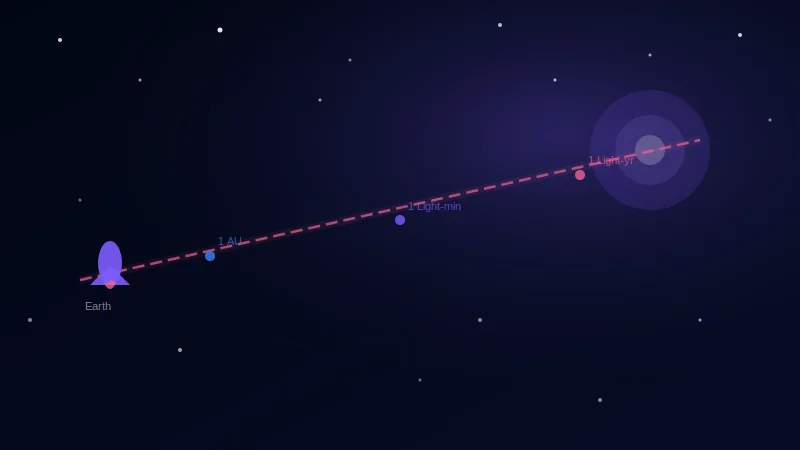
Drive to the nearest star at highway speed and the journey takes 44 million years. Send a radio signal and it arrives in 4.24 years. Both facts describe the same distance — the gap between our solar system and Proxima Centauri — and together they say something profound about how vast the universe actually is. Once you understand cosmic scales, the night sky looks completely different.
Why We Need Special Units for Space
Kilometres work fine within our solar system — the Moon is 384,400 km away, Mars gets as close as 54.6 million km. But once you step outside the solar system, the kilometre becomes as useful as measuring the distance from London to Karachi in millimetres. You need different units. Astronomers use three main units. The Astronomical Unit (AU) — the average Earth-Sun distance of 149.6 million km — is practical for solar system measurements. The light-year — 9.461 trillion km, or 63,241 AU — is the standard for stellar and galactic distances. And the parsec (3.26 light-years) is what professional astronomers prefer because it emerges naturally from the parallax measurements used to calculate stellar distances.
Converting between these units immediately conveys scale. Pluto orbits at 39.5 AU — 5.9 billion km. The Oort Cloud, the solar system's outermost region, extends to roughly 100,000 AU — 1.58 light-years. Proxima Centauri sits 4.24 light-years away — 268,000 AU — so far that it takes light itself over four years to cross the gap between us. No human-made spacecraft has traveled more than 0.002 light-years from Earth. The nearest star is over 2,000 times farther than we have ever sent anything.
The Speed of Light: How Fast Is Fast?
Light moves at 299,792 km per second — call it 300,000 km/s. In practical terms: it circles the Earth 7.5 times every second. It reaches the Moon in 1.28 seconds. The sunlight on your skin right now left the Sun 8 minutes and 20 seconds ago. Jupiter is 33 to 52 light-minutes away depending on where both planets sit in their orbits. Neptune is about 4 hours out.
At cosmic scales, even light speed starts to feel slow. When you look at the Andromeda galaxy — the most distant thing visible to the naked eye — you're seeing light that left it 2.537 million years ago, before modern humans existed as a species. Looking at a galaxy 1 billion light-years away means seeing it as it was 1 billion years ago — when Earth had single-celled life and nothing with a nervous system had yet evolved. Astronomy is, fundamentally, the study of the deep past. Every observation is a time capsule. The further you look, the further back in time you see, with no mechanism to observe the present state of distant objects — only their ancient light.
-->Our Solar System: The Scale in Perspective
The Sun's diameter is 1.39 million km — 109 times Earth's diameter. If the Sun were a basketball 24 cm across, Earth would be a grape seed 26 metres away. On that same scale, the nearest star — Proxima Centauri — would be 6,900 km away from the basketball Sun: roughly the actual distance from London to New York, represented in miniature. The New Horizons spacecraft, traveling at 58,536 km/h, took 9.5 years to reach Pluto at 39.5 AU. At that speed, reaching Proxima Centauri would take over 70,000 years.
The planets at average orbital distances: Mercury (0.39 AU), Venus (0.72 AU), Earth (1.0 AU), Mars (1.52 AU), Jupiter (5.2 AU), Saturn (9.58 AU), Uranus (19.2 AU), Neptune (30.05 AU). The gaps between planets — which look negligible on a standard diagram — are each hundreds of millions of kilometres of almost entirely empty space. The solar system is predominantly vacuum, with tiny islands of matter separated by distances that dwarf anything in ordinary human experience. If the solar system were shrunk so that Earth were the size of a pea, the Sun would be a grapefruit 24 metres away — and Proxima Centauri would be another grapefruit 6,000 km distant, with nothing in between.
The Nearest Stars: Our Stellar Neighbourhood
Proxima Centauri at 4.24 light-years is our nearest stellar neighbour — a red dwarf orbiting the larger Alpha Centauri binary system (two Sun-like stars orbiting each other at 4.37 light-years). Proxima Centauri b, a potentially habitable planet orbiting within Proxima's habitable zone, is one of the most discussed targets for future space exploration — though Proxima's frequent intense UV flares likely create a challenging environment for surface life as we know it. Barnard's Star at 5.96 light-years has the largest proper motion of any known star, visibly shifting across our sky fast enough to move a full Moon's width in 180 years — a detectable indication of how close it is by astronomical standards.
Sirius — the brightest star in our night sky at apparent magnitude −1.46 — sits 8.58 light-years away. When you look at Sirius tonight, you see light that left it in early 2017. Looking at stars 100 light-years away means seeing them as they were when your grandparents were born. At 1,000 light-years: the medieval era. At 10,000 light-years: before human civilization. Every point of light in the night sky is a window into a different era of the past, with no way to know the present state of any star you observe — they could have changed, moved, or even died since the light reaching your eyes departed.
The Milky Way: Our Galaxy in Numbers
The Milky Way is a barred spiral galaxy roughly 105,700 light-years in diameter — a disk about 1,000 light-years thick through most of its structure, thicker toward the central bulge. It contains 200–400 billion stars; the uncertainty reflects the difficulty of counting stars obscured by interstellar dust in the galactic plane. Our solar system sits approximately 26,000 light-years from the galactic centre, in a minor spiral feature called the Orion Arm, completing one orbit of the galactic centre every 225–250 million years — sometimes called a "galactic year." Earth has completed roughly 18 galactic orbits since its formation.
At the Milky Way's centre sits Sagittarius A* — a supermassive black hole of approximately 4 million solar masses. Invisible in optical light through 26,000 light-years of interstellar dust, it was first imaged directly by the Event Horizon Telescope collaboration in 2022: a bright ring of superheated gas surrounding a dark central shadow, created by the combined resolving power of radio telescopes spread across the entire Earth working as a single instrument. The image represents the angular resolution equivalent to seeing a golf ball on the Moon from Earth.
The Local Group and the Scale of Galaxy Clusters
The Milky Way belongs to the Local Group — approximately 54 galaxies spanning roughly 10 million light-years. The Andromeda Galaxy (M31) at 2.537 million light-years is our nearest large galactic neighbour. It approaches us at approximately 110 km/s, and in approximately 4.5 billion years, Andromeda will merge with the Milky Way in a gravitational interaction spanning hundreds of millions of years. The collision will not destroy individual stars — the distances between stars are too vast for stellar collisions — but it will dramatically rearrange orbital structures and ultimately form a single elliptical galaxy, sometimes called "Milkomeda."
Beyond the Local Group, the Virgo Supercluster spans 110 million light-years and contains about 100 galaxy groups and clusters. The Laniakea Supercluster — our local supercluster, identified in 2014 — spans approximately 520 million light-years and contains the mass of 100 quadrillion suns. The observable universe — the region from which light has had time to reach us since the Big Bang 13.8 billion years ago — stretches approximately 93 billion light-years in diameter (larger than 13.8 billion light-years because space itself has expanded during the light's journey) and contains approximately 2 trillion galaxies. Every star you can see with the naked eye is within roughly 4,000 light-years of Earth — a tiny bubble within a galaxy that is itself a small member of a structure of almost incomprehensible scale.
Why Interstellar Travel Is So Difficult
The Parker Solar Probe, the fastest human-made object, has reached speeds of approximately 690,000 km/h. At this speed, reaching Proxima Centauri would take roughly 6,500 years. Proposed nuclear pulse propulsion concepts — using nuclear explosions to propel spacecraft — might achieve 3–10% of the speed of light, reducing the transit time to 50–140 years. Theoretical laser sail concepts, pushing a gram-scale probe with a powerful Earth-based laser, might achieve 20% of light speed — arriving at Proxima in roughly 22 years. All concepts face daunting engineering challenges beyond propulsion: deceleration at the destination requires onboard propellant, and interstellar gas and dust impacting a spacecraft at even 1% light speed carries radiation energy equivalent to multiple nuclear explosions per second on the leading surface.
These distances are not merely large — they represent a near-insurmountable engineering barrier with any technology currently foreseeable. The energy required to accelerate even a small spacecraft to a meaningful fraction of light speed exceeds current global annual energy production by orders of magnitude. Interstellar travel remains in the domain of serious theoretical proposal and long-range speculation rather than engineering feasibility, and the distances involved suggest this is likely to remain true for centuries even under optimistic assumptions about technological progress. We are isolated not by choice but by physics.
Exoplanets: Worlds Orbiting Other Stars
Since the first confirmed exoplanet discovery in 1992, astronomers have confirmed over 5,700 planets orbiting other stars. The Kepler Space Telescope (2009–2018) found thousands by detecting the tiny dimming of starlight as planets transit their host stars — a brightness decrease of 0.01% or less, requiring extraordinary photometric precision. TESS, launched in 2018, extended this survey to brighter, nearer stars accessible to follow-up observation. The James Webb Space Telescope, fully operational since 2022, can analyze exoplanet atmospheres through transmission spectroscopy — detecting water vapor, carbon dioxide, methane, and other molecules that might indicate biological activity.
The TRAPPIST-1 system at 39 light-years contains seven roughly Earth-sized planets orbiting a red dwarf star, three within the habitable zone where liquid water could exist on surfaces with appropriate atmospheric conditions. These worlds are the current leading candidates for biosignature searches with JWST. Statistical analyses suggest most Sun-like stars host multiple planets, with potentially billions of Earth-sized planets in galactic habitable zones across the Milky Way. The question has shifted from "are there other planets?" — we know there are trillions — to "does life arise wherever conditions allow, and how often does complexity emerge?" These are questions that current technology is genuinely beginning to address for the first time in human history.
Additional context — Voyager 1, launched in 1977, is the most distant human-made object from Earth, and a radio signal from it currently takes over 22 hours to reach Earth one-way — meaning a command sent to the spacecraft today wouldn't be received, and any response wouldn't return, for nearly two full days round-trip.
Additional context — Parallax, the technique used to measure distances to nearby stars, works by observing a star's apparent position shift against distant background stars as Earth orbits the sun — the same principle behind depth perception from having two eyes, just applied at a baseline of roughly 300 million kilometers instead of a few centimeters.