Metric vs Imperial: Why the US Has Not Switched and What It Costs
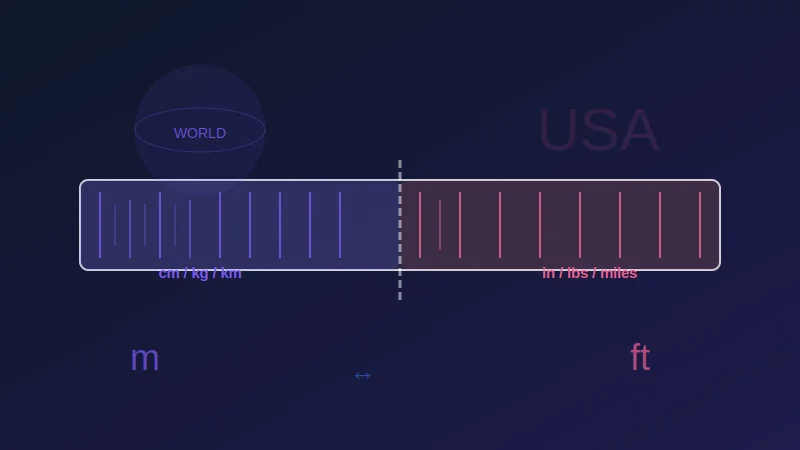
Only three countries in the world haven't officially adopted the metric system as their primary standard: the United States, Liberia, and Myanmar. That quirk of measurement has destroyed a spacecraft, nearly brought down a commercial airliner, and costs billions of dollars every year in inefficiency and error. Here's the full story of why this disagreement refuses to go away.
The Two Systems Explained
The metric system — the International System of Units, or SI — is built on powers of ten. One kilometre equals 1,000 metres; one metre equals 100 centimetres; one centimetre equals 10 millimetres. Conversions are trivial arithmetic. The system emerged from the French Revolution and gradually became the global standard for science, medicine, and international trade.
The imperial system is a patchwork of medieval English units with no consistent internal logic. One mile equals 1,760 yards, which equals 5,280 feet, which equals 63,360 inches. One gallon equals 4 quarts, 8 pints, or 128 fluid ounces. These relationships weren't designed — they accumulated over centuries. Feet were literally the length of a human foot; inches were a thumb-width; miles came from 1,000 Roman paces. Converting between imperial units means memorising arbitrary numbers with no pattern to help you. You just have to know them.
The $327 Million Mars Mistake
On 23 September 1999, NASA's Mars Climate Orbiter burned up in the Martian atmosphere. The cause: one engineering team used imperial units (pound-force seconds) for thruster data while NASA's navigation software expected metric units (newton-seconds). Nobody caught the mismatch across months of mission planning. The navigation error was 170 km — the spacecraft entered the atmosphere at the wrong angle and disintegrated. The mission cost $327 million. The investigation report cited specifically: "the failure to use metric units in the coding of a ground software file."
This is dramatic but not unique. A 1983 Air Canada Boeing 767 ran out of fuel mid-flight because ground crew mixed kilograms and pounds — they loaded 22,300 pounds of fuel instead of 22,300 kilograms required, dramatically short of what was needed. The plane glided without power to an emergency landing at a disused airstrip in Gimli, Manitoba — now called the "Gimli Glider" incident. A 1999 hospital reported a medication dosing error where a patient received ten times the intended drug dose due to confusion between milligrams and micrograms. Unit errors have destroyed spacecraft, stranded aircraft, and harmed patients. They are not theoretical risks.
-->The Economic Cost of Dual Systems
For US industries exporting to metric countries, maintaining dual measurement systems — dual manufacturing specifications, dual engineering standards, dual documentation, dual workforce training — adds estimated costs of $10–17 billion annually, depending on the methodology used. The US construction industry routinely deals with measurement inconsistencies between metric engineering designs and imperial site measurements, producing conversion errors and rework costs. The US pharmaceutical industry presents a cautionary example: the FDA requires metric dosing for all medications, but consumer packaging frequently shows imperial equivalents, creating persistent dosing confusion particularly for liquid children's medications administered by teaspoon rather than milliliter.
Studies have documented pediatric dosing errors attributable to teaspoon-versus-milliliter confusion — 5 ml equals one teaspoon, but parents administering medication by spoon use different-sized spoons, creating dosing variability of 20–50%. This entire category of medical error would be eliminated in a fully metric consumer environment. The cost of maintaining imperial units in consumer contexts is not just economic — it is directly measurable in preventable medication errors that harm people who could not reasonably be expected to know that their tablespoon differs from the standardized measure referenced in dosing instructions.
Why the US Has Not Switched
The US has attempted to convert to metric — twice. The Metric Conversion Act of 1975 established a voluntary metrication program that largely failed due to lack of public enthusiasm and industry resistance to retooling costs. The Omnibus Trade and Competitiveness Act of 1988 made metric the "preferred system" for federal agencies and required metric labeling on consumer products — but with so many exceptions that meaningful change was minimal. The barriers today are cultural inertia (Americans think and communicate in miles and Fahrenheit), infrastructure replacement cost (replacing road signs alone would cost an estimated $4–8 billion), industry retooling, and the political difficulty of mandating broadly unpopular change in a democratic system where the daily inconvenience of conversion falls on ordinary voters rather than on specialists who already use metric for professional work.
The profound irony: US science, medicine, military, aviation, and most manufacturing already use metric exclusively. American engineers design in metric. American physicians prescribe in metric. American aircraft navigate in metric altitudes and distances. The US does not maintain a separate measurement system for technical work — it maintains a consumer-facing overlay of historical unit names on top of metric that already underlies everything technically important. The imperial system has been officially defined in metric terms since 1959: one inch is exactly 25.4 millimetres by US legal definition. The measurement is metric; only the label persists in imperial form.
Fahrenheit vs Celsius: A Real Trade-off
Fahrenheit was defined in 1724. His 0°F reference was a saturated saltwater ice mixture; 96°F was approximately body temperature as he measured it. The result is a scale where water freezes at 32° and boils at 212° — numbers with no physical significance. Celsius defined specifically around water: 0° equals freezing, 100° equals boiling. For any scientific purpose, Celsius and Kelvin (which uses the same degree size starting from absolute zero) are the appropriate choice. No working scientist anywhere uses Fahrenheit.
The strongest honest argument for Fahrenheit is experiential: the range 0–100°F maps reasonably well to human weather experience from extremely cold to extremely hot, providing somewhat finer apparent granularity for daily temperature communication than Celsius's 0–40°C daily range. A Celsius user anchors on: 0°=freezing, 10°=cold, 20°=comfortable, 30°=warm, 40°=very hot. Five mental anchors cover all everyday weather. This is a real if modest practical advantage for weather conversation — which is why Fahrenheit persists in everyday American life despite having zero scientific advantages and every scientific disadvantage.
Cooking Across Systems
Cooking is where the measurement collision is most practically felt in daily life. American recipes specify "1 cup flour" or "2 tablespoons butter" — volume-based measurements. European and professional culinary traditions use weight in grams. Weight-based measurement is actually more precise for baking, where density variations in flour measurement by volume can alter results by 30% depending on whether flour is scooped, spooned, or sifted — a variation that noticeably affects bread and cake texture in ways that volume measurement cannot prevent.
Professional and serious home bakers worldwide have largely adopted weight measurement regardless of national conventions, because the precision benefits are significant and a kitchen scale is inexpensive and more versatile than a set of volume measures. The practical resolution for navigating both systems: weight for baking where precision matters, volume for cooking where it matters less, and a few memorized anchors for quick recipe conversion: 1 cup ≈ 240 ml, 1 tablespoon ≈ 15 ml, 1 teaspoon ≈ 5 ml, 1 pound ≈ 454 grams, 1 ounce ≈ 28 grams. Our unit converter handles all standard cooking conversions instantly for any recipe in either system.
Practical Conversion Reference
For everyday navigation between systems, these anchors cover 95% of practical conversion needs. Length: 1 mile = 1.609 km; 1 km = 0.621 miles; 1 metre = 3.281 feet; 1 inch = 2.54 cm; 1 foot = 30.48 cm. Weight: 1 kg = 2.205 pounds; 1 pound = 453.6 grams; 1 ounce = 28.35 grams. Volume: 1 litre = 1.057 US quarts; 1 US gallon = 3.785 litres; 1 fl oz = 29.57 ml. Temperature: °C = (°F − 32) × 5/9; °F = (°C × 9/5) + 32. Key temperature anchors: 0°C = 32°F (freezing), 10°C = 50°F (cold), 20°C = 68°F (comfortable), 37°C = 98.6°F (body temperature), 100°C = 212°F (boiling).
For Pakistani students studying or working internationally, or for anyone working with American colleagues and documents, memorizing the kilometer-to-mile, kilogram-to-pound, and the five key temperature anchors covers the overwhelming majority of daily conversion needs. The rest can be handled quickly with a unit converter. Comfortable dual-system literacy is a genuine professional skill for anyone working with American counterparts in engineering, medicine, aviation, or any technical field where measurement precision is professionally important.
Additional context — NASA's Mars Climate Orbiter was lost in 1999 specifically because one engineering team's software used metric units (newton-seconds) while another used imperial units (pound-seconds) for the same navigation calculations — a unit mismatch that sent a $327 million spacecraft off course and destroyed it in the Martian atmosphere.
Additional context — The metric system itself is not a single fixed, unchanging standard — it has been formally redefined multiple times. As recently as 2019, the kilogram was redefined based on a fixed value of the Planck constant rather than a physical reference object, ending its historical dependence on a single platinum-iridium cylinder kept in France.