Scientific Calculators: A 400-Year History of Human Computation
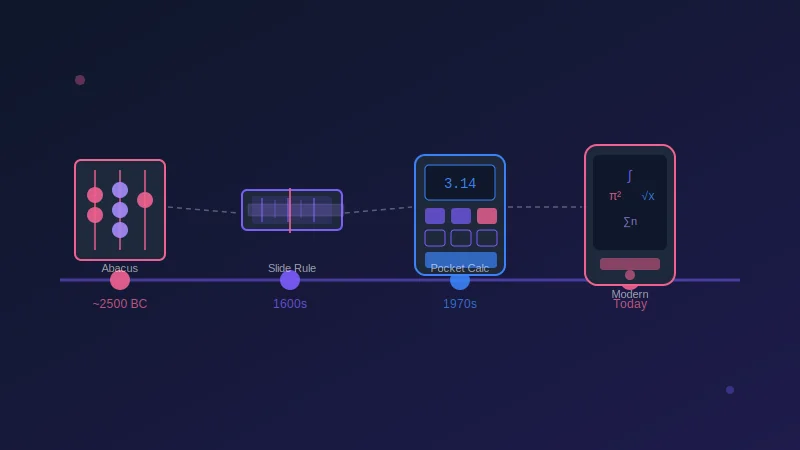
The calculator app on your phone does in a millisecond what took our ancestors hours of careful manual work. But getting to that millisecond took four centuries of relentless invention — mechanical rods, analog slides, electric circuits, and silicon chips. And the final chapter of that story is oddly poignant: a precision instrument that took 300 years to perfect was rendered obsolete in under two years once something better came along.
The Pre-Calculator Era: Calculating by Hand
For most of human history, complex calculations happened entirely in someone's head or on paper — and they were painfully slow. A skilled mathematician could spend hours computing logarithm or trigonometry tables with enough precision for navigation or engineering work. Mistakes were common, and sometimes devastating: a wrong figure in a ship's navigation tables could send sailors hundreds of miles from where they thought they were. The pressure to calculate faster and more reliably wasn't theoretical. It was tied to survival, commerce, and military advantage in very direct ways.
In 1617, Scottish mathematician John Napier introduced what became known as Napier's Bones — multiplication rods of bone or ivory that allowed multi-digit numbers to be multiplied quickly through physical alignment. Around the same time, Edmund Gunter invented the logarithmic ruler, a physical scale that made multiplication and division into a measurement problem. Slide two of Gunter's rulers against each other and you've invented the slide rule — which dominated scientific and engineering calculation for the next 350 years. These weren't novelties. They were the calculators of their era — used by the best mathematical minds alive to build cathedrals, navigate oceans, and design the machines of the industrial age.
The Slide Rule: Three Centuries of Analog Computing
William Oughtred combined two logarithmic scales into the first recognisable slide rule in 1622. The principle is elegantly simple: slide two scales against each other, align the numbers, read the result. With practice, a trained engineer could work through calculations faster than many people type on a modern calculator. Slide rules became the defining tool of engineering culture, carried as a professional badge alongside the profession itself.
Every engineer who designed the Apollo spacecraft, built the Hoover Dam, or engineered early jet engines used a slide rule. Neil Armstrong reportedly carried one on the Moon. IBM engineers designed the first mainframe computers using slide rules to verify calculations. At their peak in the 1960s, over 40 million slide rules were in use worldwide. Their limitation was precision — a good slide rule gave three or four significant figures, sufficient for most engineering but insufficient for scientific research requiring eight to twelve. They also could not handle addition or subtraction natively — only multiplication, division, and the transcendental functions derivable from logarithms. These limitations were endured for centuries because nothing better existed. Then, within 24 months of the HP-35's release, the slide rule market collapsed completely.
-->Mechanical Calculators: From Pascal to Babbage
While slide rules dominated portable computation, inventors simultaneously built mechanical adding machines. Blaise Pascal built the "Pascaline" in 1645 — a gear-driven device that could add and subtract up to eight digits. He reportedly built over 50 prototypes before achieving reliable operation. Gottfried Wilhelm Leibniz improved on Pascal's design with the "Stepped Reckoner" in 1672, adding multiplication and division through stepped gear cylinders. These machines were expensive, fragile, and required skilled maintenance — luxuries for royal courts and wealthy merchants rather than everyday tools.
Charles Babbage conceived the most ambitious mechanical computing project in history — the "Difference Engine" in the 1820s, designed to compute polynomial functions to 31 decimal places using steam power. Government funding ran out before completion, but his conceptual "Analytical Engine" incorporated conditional branching and loops — the conceptual foundation of all modern programming. Ada Lovelace wrote what historians recognize as the first computer algorithm for this machine. By the early 20th century, mechanical calculators like the hand-cranked Curta and electric Marchant machines were standard office equipment — a skilled Marchant operator could multiply two 10-digit numbers in about 8 seconds, competitive with careful mental arithmetic for multi-digit calculations.
Electronic Calculators: The 1960s Revolution
The first truly electronic desktop calculators appeared in 1961. The ANITA from Britain used vacuum tubes and Nixie display tubes to perform all four arithmetic operations electronically — instantly and silently, unlike the noisy clacking of mechanical machines. It weighed 33 pounds and cost the equivalent of a small car, but it worked. Transistors quickly replaced vacuum tubes, prices fell, and by 1964 several companies competed vigorously in the desktop electronic calculator market. The pace of innovation was extraordinary — devices that cost thousands of dollars in 1964 cost hundreds in 1970 and tens of dollars by 1975.
The crucial breakthrough came in 1968 when Hewlett-Packard introduced the HP 9100A — widely considered the first true scientific desktop calculator. It computed trigonometric and exponential functions electronically using read-only memory storing algorithm tables. HP sold it for $4,900 (roughly $40,000 in 2026 dollars). Universities ordered them faster than HP could manufacture them. Scientists who had previously spent hours computing function values by hand or from printed tables now had results in seconds. The professional transformation was immediate and irreversible.
The HP-35: The Calculator That Killed the Slide Rule
In 1972, HP co-founder Bill Hewlett challenged his engineers to build a scientific calculator that fit in a shirt pocket. The result — the HP-35 — was the world's first handheld scientific calculator. It computed all trigonometric functions, logarithms, and exponentials in a device smaller than a paperback book, at $395 (approximately $2,800 in 2026 dollars). It used Reverse Polish Notation (RPN) — operators entered after operands — which confused novices but dramatically accelerated calculation for experienced users. Engineers who learned RPN reported never wanting to return to algebraic notation.
The HP-35 was so immediately successful that it killed the slide rule market within two years of its release. A 350-year reign of analog computation ended in less than 24 months — one of the fastest technology displacement events in commercial history. Texas Instruments followed with competing products, and price competition drove rapid innovation throughout the 1970s. By 1975, a basic scientific calculator cost under $50. By 1980, under $20. By 1985, drugstores sold scientific calculators as impulse-purchase items. The democratization of mathematical computation was complete.
The CORDIC Algorithm: Mathematics Hidden Inside Every Calculator
Computing trigonometric functions electronically is not straightforward — you cannot store tables for every possible angle. Early scientific calculators used an algorithm called CORDIC (COordinate Rotation DIgital Computer), developed by Jack Volder in 1959. CORDIC computes trigonometric values through a series of simple additions and bit-shift operations — hardware operations that primitive microprocessors could handle efficiently without floating-point multiplication hardware. Each CORDIC iteration converges to the correct answer with approximately one bit of additional precision, making the computation both hardware-efficient and mathematically elegant.
Modern processors use polynomial approximations — Chebyshev or minimax polynomials — to compute transcendental functions to 15+ decimal places in a handful of processor clock cycles. The mathematical sophistication required to compute sin(47.3°) to 15 digits of precision in microseconds represents decades of accumulated research in numerical analysis. Every time you press sin on a calculator, this invisible mathematical machinery executes. The calculation that your smartphone performs casually would have required hours of manual work from a skilled mathematician in 1900 — and would have been impossible at any speed for most of the population.
Graphing Calculators and the Classroom Revolution
Casio introduced the first graphing calculator — the fx-7000G — in 1985. It could display graphs of mathematical functions on a small LCD screen, fundamentally changing how mathematics could be explored visually. The Texas Instruments TI-81 (1990) and TI-83 (1996) became the dominant US classroom tools, a position TI maintains largely due to regulatory inertia in standardized testing policy. The TI-83 created an entire student subculture: students programmed games, formula sheets, and custom utilities, discovering programming through a device intended for mathematics class.
Computer Algebra Systems (CAS) calculators emerged in the early 1990s. The HP-48 and TI-89 could solve integrals symbolically, factor polynomials, and simplify algebraic expressions — capabilities previously confined to expensive computer software. These devices brought graduate-level mathematical computation into high school students' hands for a few hundred dollars. The mathematical sophistication accessible to an average student in 1995 exceeded what was available to a professional engineer in 1965 — a remarkable compression of technological access across a single generation.
The Smartphone Era: Free Scientific Computation
By the 2010s, smartphone apps had rendered dedicated calculators obsolete for most users. Wolfram Alpha (2009) brought Computer Algebra System capabilities to any internet-connected device at no cost. Photomath (2014) allowed phones to solve handwritten equations by pointing a camera at them. AI-powered mathematics assistants can now handle not just computation but reasoning — setting up equations from word problems, explaining solution steps, identifying errors in student work. The $150 graphing calculator still required for standardized tests in 2026 uses hardware and software essentially unchanged from the 1990s — a regulatory anachronism in a world where free browser-based scientific calculators offer identical or superior functionality.
The displacement of hardware calculators by software mirrors the historical displacement of slide rules by HP calculators. The transition is slower because standardized testing policy is slower to change than market preference — but the outcome is equally inevitable. Each generation of mathematical computation tools makes the previous generation obsolete. The 400-year arc from Napier's Bones to AI-powered mathematical reasoning represents one of the most significant progressions in human intellectual infrastructure, and its continued acceleration shows no signs of slowing.
The Educational Debate: Calculators and Mathematical Understanding
Since electronic calculators became affordable in the late 1970s, educators have debated their role in mathematics education. Critics argue calculator dependence prevents students from developing number sense and mental arithmetic fluency foundational to mathematical reasoning — that knowing 7 × 8 = 56 instantly is genuinely different from being able to find the answer with a device. The concern is not irrational: mathematical research requires rapid intuitive estimation, error detection, and structural understanding that mechanical calculation tools do not provide and may even inhibit if introduced before foundational skills are established.
Proponents argue calculators free cognitive resources for higher-order mathematical thinking — conceptual understanding, problem setup, pattern recognition, and interpretation — rather than mechanical computation that machines perform better anyway. Research evidence is mixed and context-dependent. Studies consistently show calculator use does not harm — and often benefits — higher-order mathematical reasoning when introduced after basic arithmetic fluency is established and when used as an exploratory tool rather than a substitute for conceptual understanding. The consensus position in mathematics education: develop basic arithmetic fluency first without calculators, then use calculators as exploratory and efficiency tools for more complex mathematics. Knowing when to use a calculator, what to input, and whether the output is reasonable requires mathematical understanding that no calculator provides — and that is the understanding worth teaching.
Calculators as Democratization: The Deepest Story
The $5 scientific calculator available at any stationery shop today was a $4,900 specialized instrument in 1968. This 99.9% cost reduction in under 60 years is one of the steepest price declines of any technology in economic history. The consequence was profound: engineering, finance, statistics, and science became computationally accessible to people without institutional resources. A student in Karachi, Lagos, or Manila with a $5 calculator has access to computational power that would have been confined to well-funded university research departments in 1965. This equalization of computational access played an underappreciated role in the globalization of technical education and the emergence of engineering and science talent from countries that previously lacked institutional computing infrastructure. The story of the calculator is ultimately the story of how mathematical power — once a privilege of the elite — became available to anyone with a few rupees and the will to learn how to use it.
Additional context — The HP-35, released in 1972 as the first handheld scientific calculator, began as an internal engineering project that Hewlett-Packard's own market researchers advised against, predicting fewer than 10,000 units would sell — it went on to sell over 300,000 units within its first few years.
Additional context — Slide rules, the primary calculation tool scientific calculators eventually replaced, could not perform addition or subtraction at all — they were purely multiplication, division, and logarithmic tools, meaning engineers using them still did basic addition by hand even during the slide rule's peak era of use.