Solar Energy for Your Home in 2026: The Complete Cost, Savings, and Installation Guide
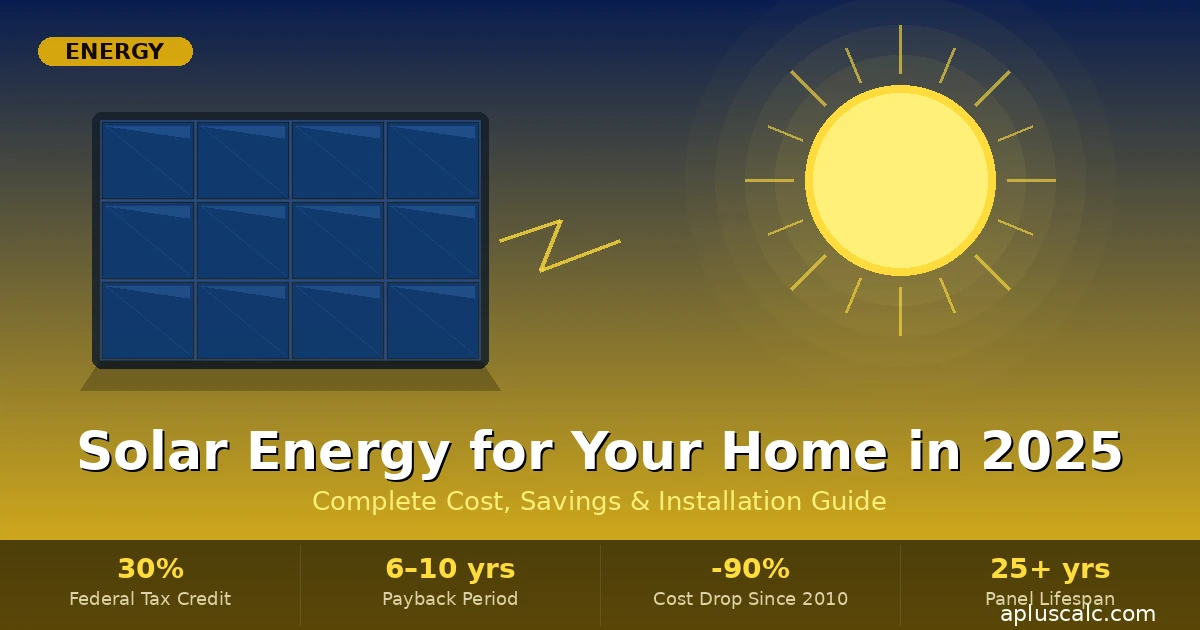
A decade ago, putting solar on your house was a bold statement — expensive, niche, and something you did more for the environment than for your wallet. That calculation has completely flipped. Solar costs have crashed 90% since 2010, the US federal government will give you back 30% of whatever you spend, and electricity prices keep climbing. The math now works in most of the country — but navigating quotes, contractors, tax credits, and financing is genuinely confusing without a clear guide. That's what this is. Yet most homeowners still don't have solar — primarily because the decision involves navigating a complex web of costs, incentives, contractors, and financing options that is genuinely confusing without a guide. This article provides that guide: everything you need to know to make an informed solar decision in 2025.
How Solar Panels Work — The Basics
Solar photovoltaic (PV) panels generate electricity through the photoelectric effect: photons from sunlight knock electrons loose from silicon atoms in the panel, creating an electrical current. This direct current (DC) flows to an inverter that converts it to alternating current (AC) — the type used by household appliances and the electrical grid. Excess electricity flows back to the grid (in net metering arrangements) or to battery storage. When the sun isn't generating enough power, electricity is drawn from the grid or battery as normal.
Modern residential solar panels are typically monocrystalline silicon, with efficiencies ranging from 19% to 23% (the percentage of incoming sunlight converted to electricity). Higher efficiency panels produce more electricity per square foot, which matters if roof space is limited but costs more per watt. Leading brands include SunPower, REC Group, Panasonic, LG (discontinued production but panels still available), and Qcells. For most homeowners, a mid-range monocrystalline panel from a reputable manufacturer (Qcells, REC, Jinko) offers the best value — the marginal efficiency gains from premium brands rarely justify their price premium.
The other major components: the inverter converts DC to AC (options: string inverters, microinverters per panel, or power optimizers); the mounting system attaches panels to your roof (racking must be designed for your specific roof type and local wind/snow loads); and the monitoring system tracks production in real time via an app. Most modern systems also include a smart meter or communication equipment that enables net metering with your utility.
Solar Costs in 2026: What You'll Actually Pay
The national average cost of residential solar in the US in 2026 is approximately $2.80–$3.50 per watt installed, before incentives. For a typical 8–10 kW system (sufficient for most 2,000–3,000 sq ft homes), total costs range from $22,000–$35,000 before the federal tax credit. After the 30% federal tax credit, net costs are $15,000–$24,500. State and local incentives can reduce this further by $1,000–$5,000+ depending on location.
| System Size | Typical Home Size | Gross Cost | After 30% Credit | Annual Savings |
|---|---|---|---|---|
| 5 kW | Small (1,200 sq ft) | $14,000–$18,000 | $9,800–$12,600 | $700–$1,200 |
| 8 kW | Medium (2,000 sq ft) | $22,000–$28,000 | $15,400–$19,600 | $1,100–$1,900 |
| 10 kW | Large (2,800 sq ft) | $28,000–$35,000 | $19,600–$24,500 | $1,400–$2,400 |
| 12 kW | Very Large (3,500+ sq ft) | $34,000–$42,000 | $23,800–$29,400 | $1,700–$2,900 |
The cost per watt varies significantly by location, with California, New England, and Hawaii typically higher ($3.20–$4.00/W) and Midwest and Southeast states lower ($2.60–$3.20/W). Roof complexity (multiple angles, steep pitch, difficult access) increases installation cost by 10–20%. Battery addition adds $8,000–$15,000 for a single Tesla Powerwall or equivalent. Labor is typically 10–15% of total system cost in most markets.
These figures are for direct purchase. Solar loans, leases, and PPAs (power purchase agreements) change the upfront cost dramatically — from $0 upfront to the full cost — but also affect who captures the tax credit and the total long-term value. The financing section below covers these trade-offs in detail.
Federal, State, and Local Incentives
The Residential Clean Energy Credit (federal tax credit) allows homeowners to claim 30% of their total solar installation cost as a direct reduction in federal income taxes owed. For a $25,000 system, this is a $7,500 credit — not a deduction, but a direct dollar-for-dollar reduction in what you owe the IRS. The credit carries forward if you don't owe enough taxes to use it all in one year. It applies to the full system cost including panels, inverter, mounting, wiring, and labor. The 30% rate is locked in through 2032.
State incentives vary dramatically. California offers net energy metering and property tax exemption for solar. New York provides a 25% state tax credit (up to $5,000) plus NYSERDA rebates. Texas offers no direct state incentive but strong local utility rebates in some areas. Massachusetts has the SMART program paying per kWh produced. Florida offers a full property tax exemption and sales tax exemption on equipment. Research your specific state's Database of State Incentives for Renewables and Efficiency (DSIRE) for current programs.
Net metering — the policy allowing you to sell excess solar electricity to the grid and receive credit on your bill — is available in most US states but is being scaled back in some markets. California's NEM 3.0 reduced buyback rates significantly in 2023, changing the economics for homeowners who relied on high export compensation. Understanding your utility's net metering policy is essential before sizing a system — over-sizing may not be financially beneficial in low-compensation rate regimes.
How Many Solar Panels Does Your Home Need?
Sizing a solar system requires four inputs: your annual electricity consumption (from utility bills), your location's peak sun hours, your target offset percentage, and the wattage of your chosen panels. Most homeowners target 80–100% offset of their electricity consumption.
The calculation: System size (kW) = Annual kWh consumption ÷ (Annual sun hours × 365 × 0.8). The 0.8 factor accounts for system inefficiencies (heat losses, inverter losses, wiring losses, dust). Example: A home using 12,000 kWh/year in Phoenix (5.5 peak sun hours) needs 12,000 ÷ (5.5 × 365 × 0.8) = 7.47 kW, typically rounded to 8 kW. The same home in Seattle (3.5 peak sun hours) needs 12,000 ÷ (3.5 × 365 × 0.8) = 11.7 kW — nearly 50% more panels for the same offset.
Panel count = System size (W) ÷ Panel wattage. An 8 kW system using 400W panels requires 20 panels. A 12 kW system requires 30 panels. Standard panels are approximately 1.7m × 1.0m (about 18 sq ft each), so a 20-panel system requires roughly 360 sq ft of usable roof space oriented south with minimal shading. Most two-story homes have adequate roof area for systems up to 12 kW.
Roof orientation and shading are the most critical site factors. South-facing (in the Northern Hemisphere) maximizes production — typically 15–25% more than east/west-facing. Shading from trees, chimneys, or neighboring buildings dramatically reduces production; even partial shading on one panel can reduce the entire string's output with traditional string inverters. Microinverters or power optimizers (added cost: $500–$2,000 per system) isolate each panel, preventing shading from affecting neighbors and are worth the investment for complex roof layouts.
Payback Period and ROI Calculation
Want to run the numbers for your home? Start with our Electricity Bill Calculator to find your current annual spend — that's your baseline for savings. The payback period calculation: Net System Cost ÷ Annual Savings = Payback Years. Annual savings = (Annual kWh production × Local electricity rate) + (Net metering credit for exported energy). Example: 8 kW system in Denver producing 10,000 kWh/year at $0.15/kWh electricity rate. Annual savings = $1,500. Net system cost after 30% credit = $18,000. Payback = 18,000 ÷ 1,500 = 12 years.
The calculation improves significantly with: higher electricity rates (California at $0.25/kWh cuts payback to 7.2 years in the same example), state incentives (New York's additional 25% credit reduces net cost to ~$13,500 in our example, cutting payback to ~9 years), and electricity price inflation (utility rates have increased 3–4% annually for decades; a solar system locks in your energy cost, making the savings grow over time in real terms).
A better way to think about it: use our Compound Interest Calculator to compare what that same $18,000 would grow to in the stock market vs. what the solar system saves you. Internal rate of return (IRR) is a better metric than payback for comparing solar to other investments. Most residential solar systems in good markets deliver IRRs of 8–15% after federal incentives — competitive with stock market returns but with zero correlation to financial market performance and with the added benefit of inflation protection as electricity rates rise. The investment also increases home value: a Lawrence Berkeley National Laboratory study found solar adds approximately $4/W to home value, meaning a 10 kW system adds ~$40,000 to home value — comparable to a kitchen renovation but with actual financial returns.
Battery Storage: Do You Need It?
Battery storage gets marketed heavily alongside solar — and it makes sense why, conceptually. Store your solar power, use it at night, never need the grid. But whether it's financially worth adding to your system depends heavily on where you live and how your utility handles excess solar. The question of whether to add battery storage depends on your utility's net metering policy, your electricity rates, local outage frequency, and your risk tolerance.
If your utility offers full retail net metering (crediting you the same rate for exported power as you pay for imported power), batteries typically don't improve the financial case for solar — you're effectively "using the grid as a battery" for free. If your utility has time-of-use rates (charging more during peak evening hours), batteries allow you to use stored solar power during expensive periods and can meaningfully improve economics. If grid reliability is poor (rural areas, areas prone to storms), backup power capability is a genuine lifestyle benefit worth paying for.
Battery economics: a Tesla Powerwall (13.5 kWh usable) costs approximately $11,500 installed. At $0.15/kWh electricity avoided, it would need to cycle approximately 5,100 times at full capacity to pay for itself — at one full cycle per day, that's 14 years, roughly coinciding with battery replacement. In low-rate, high-reliability areas, batteries are a comfort purchase rather than a financial one. In high-rate or low-reliability areas, they can be financially justified while also providing resilience.
The 30% federal tax credit applies to battery storage installed alongside solar (or in some cases added later). This improves battery economics significantly and should be factored into any payback calculation.
Financing Options: Buy, Loan, Lease, or PPA
Cash purchase delivers the best long-term economics. You capture the full tax credit (30% of system cost), own the system outright, receive 100% of the electricity savings, and have no interest costs. The disadvantage is the upfront capital requirement — $15,000–$25,000 after the tax credit is a significant outlay. Homeowners with available savings and planning to stay in the home 10+ years should consider cash purchase as the highest-return option.
Solar loans allow you to own the system with no or low money down while spreading payments over 5–20 years. Use our Loan EMI Calculator to compare monthly payments across different loan terms before you commit. You still receive the federal tax credit. Loan interest rates range from 4–9% depending on credit score and loan term. At 6% interest over 10 years, a $20,000 loan adds approximately $6,600 in interest costs — reducing but not eliminating the financial advantage over leasing. Secured solar loans (using your home as collateral) offer better rates than unsecured. Best for homeowners with limited savings but good credit who want ownership benefits.
Solar lease: You pay a fixed monthly amount to "rent" panels installed on your home. The installer owns the system and receives the tax credit. You receive lower electricity bills in exchange for lease payments. Typically $0 down, predictable monthly costs, and the installer handles maintenance. The disadvantage: you don't capture the tax credit, your savings are lower than ownership, and leased systems can complicate home sales (buyers must assume the lease or it must be bought out). Generally the worst financial option but the most accessible for households with poor credit or limited cash.
Power Purchase Agreement (PPA): Similar to lease, but you pay per kWh produced rather than a fixed monthly fee. Can be structured with very low rates (cheaper than utility rates) and escalating clauses (rate increases built in). Same disadvantages as leasing. Works best for homeowners who want solar's environmental benefits with minimal financial complexity and don't care about maximizing financial returns.
How to Choose a Solar Installer
The installer you choose has enormous impact on your solar experience. Poor installation causes roof damage, underperformance, and difficult warranty situations. The solar industry still has significant quality variation, and the lowest bid is rarely the best choice.
Key criteria: NABCEP (North American Board of Certified Energy Practitioners) certification is the gold standard for installation quality — prioritize companies employing NABCEP-certified installers. Get three or more quotes, and compare the full value proposition rather than just price — panel wattage, inverter type, warranty terms, production estimates, and company stability all matter. A company that won't be around in five years to honor their 25-year warranty is not really offering that warranty. Check reviews on Google, the Better Business Bureau, and EnergySage's marketplace (which lets you compare multiple installers simultaneously and provides transparency on pricing).
Red flags: pressure tactics to "sign today or lose the deal"; promises of zero electricity bills without showing calculation assumptions; third-party door-to-door sales on behalf of an installer you can't easily research; unusually low production guarantees that limit their performance responsibility. The solar sales industry has evolved considerably but still has bad actors — take your time and verify independently.
Solar in Pakistan and India: The Local Opportunity
If you're in Pakistan, honestly, the solar conversation is different here — and more urgent. The country has experienced a solar revolution over the past three years, driven partly by necessity. With electricity costs rising dramatically (residential tariffs reaching PKR 50–70/kWh in 2024–2025) and grid reliability poor (12–18 hour loadshedding in many areas), the economics of solar plus battery storage have become extremely compelling. Pakistan has approximately 5.5–6 peak sun hours daily, among the best solar resources in the world — comparable to Arizona and better than most of Europe.
Typical Pakistani residential solar setup in 2026: a 5–10 kW on-grid or hybrid system with net metering costs PKR 800,000–1,800,000 ($2,800–$6,500 at current rates). With electricity at PKR 60/kWh and the system producing 6,000–12,000 kWh annually, annual savings are PKR 360,000–720,000 ($1,300–$2,600). Payback at current rates is 2–3 years — among the fastest anywhere in the world. The State Bank of Pakistan has also introduced solar financing schemes with subsidized interest rates, and AEDB (Alternative Energy Development Board) has established net metering regulations allowing residential customers to sell excess power to DISCOS.
India's solar sector is one of the world's largest and fastest-growing. Residential solar benefits from PM Surya Ghar scheme (2024), which provides central subsidies of ₹30,000–78,000 per household for systems up to 3 kW, plus state-level subsidies varying by state. At residential electricity rates of ₹6–12/kWh and solar system costs of ₹45,000–80,000 per kW installed, payback periods of 4–7 years are typical, with systems lasting 25+ years. Solar rooftop has grown 300% in India between 2021 and 2024, with Gujarat, Rajasthan, and Maharashtra leading adoption rates. Net metering regulations exist in most states, though the policy varies in generosity.
Additional context — Solar panel efficiency actually decreases in extreme heat despite more available sunlight — most panels lose roughly 0.3–0.5% efficiency for every degree Celsius above 25°C, which is part of why some of the highest per-panel electricity output occurs in cool, sunny climates rather than the hottest regions.
Additional context — Solar panel output degrades gradually rather than failing outright — most manufacturers warranty panels to retain around 80–92% of original output after 25 years, meaning a system installed today is expected to remain meaningfully productive for decades, not merely functional until a fixed expiration point.