AI vs Human Jobs: Which Careers Are Safe in 2026 and Which Are at Risk?
Most discussions of AI and jobs default to a simple list — safe jobs on the left, doomed jobs on the right. Reality is messier than that, and understanding the mess is actually more useful. The real shift happening right now is not "AI vs humans" — it's more like a tectonic plate movement under the entire economy, slowly but permanently changing which skills pay well, which jobs grow, and which ones quietly disappear over the next decade. If you get a clear picture of that shift, you can position yourself on the right side of it.
How AI Actually Eliminates Jobs — The Mechanism
Here's the thing most headlines get wrong: AI rarely walks in and takes someone's whole job on day one. What it actually does is pick off tasks within jobs — usually the most routine, repetitive ones first. A radiologist's job includes reading scans, consulting with patients, mentoring residents, participating in multidisciplinary teams, and making complex clinical judgments about ambiguous cases. AI can now outperform radiologists on routine scan reading for specific conditions — but the radiologist does not disappear. Their job changes: less time on routine scans, more time on complex cases, patient relationships, and clinical leadership.
The jobs that disappear entirely are those where the majority of tasks are automatable and there is no significant residual human value. A data entry clerk who spends 90% of their day entering structured information from physical forms into digital systems has very little non-automatable work remaining. An employment lawyer who spends 30% of their time on document review, 40% on client relationships, and 30% on courtroom strategy has a much larger non-automatable core. Understanding which tasks within your job are automatable — not just whether your job title sounds "techy" — is the right unit of analysis.
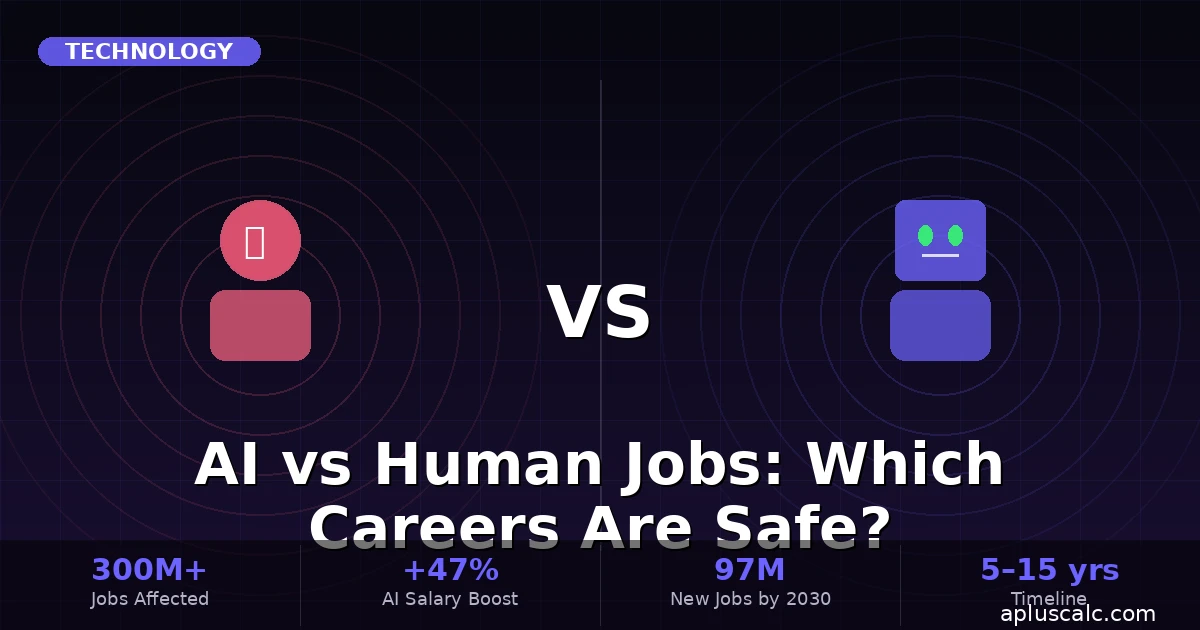
McKinsey Global Institute research suggests that roughly 30% of tasks across all occupations could be automated with currently available technology. Goldman Sachs estimated that 300 million full-time jobs globally could be affected by generative AI. These numbers sound alarming but need context: "affected" does not mean "eliminated." Most analyses show 20–30% of tasks automated within existing jobs, changing how work is done rather than making workers redundant.
The process also compounds with economic incentives. A business that can automate 30% of a role's tasks can either reduce headcount or increase throughput — and the answer depends on market conditions, growth stage, and the nature of the remaining 70%. In growing markets, businesses typically use AI-driven productivity gains to expand rather than contract. In stagnant or declining markets, the savings go straight to headcount reduction. Understanding the macro context of your industry is as important as understanding the automation risk to your specific tasks.
The High-Risk Jobs: What Research Actually Says
Oxford researchers Frey and Osborne's landmark 2013 study estimated 47% of US jobs faced "high risk" of automation within two decades. Subsequent research refined this significantly — the OECD 2016 study found only 9% of jobs in developed countries faced high automation risk, because the original study overestimated AI's ability to handle social complexity, physical unpredictability, and genuine creative judgment.
These roles face the highest probability of significant AI displacement: Telemarketers (very high risk), Data Entry Clerks (very high), Bank Tellers (high), Travel Agents (high), Bookkeepers (high), Paralegals for document review (high), Customer Service Representatives for routine queries (high), Insurance Underwriters for standard cases (moderate-high), and Translators for standard documents (moderate-high).
What these roles share: highly structured, rule-based tasks; large volumes of repetitive work; clear success metrics; and limited need for physical presence, emotional intelligence, or judgment in ambiguous situations. Artificial intelligence excels at exactly these characteristics. A telemarketer following a script, handling objections from a decision tree, and recording outcomes in a CRM is performing a function that language models now do better, cheaper, and without rest.
The displacement is already happening, not theoretical. Since ChatGPT's release in late 2022, there has been a measurable decline in postings for entry-level writing, coding, customer service, and translation roles across major job platforms. The Bureau of Labor Statistics reports declining employment in several at-risk categories. This is a present trend visible in hiring data, not a future warning.
| Job Category | Risk Level | Primary AI Threat | Timeline |
|---|---|---|---|
| Data Entry / Processing | 🔴 Very High | LLMs + OCR + RPA | Already happening |
| Basic Customer Service | 🔴 Very High | Conversational AI chatbots | 2025–2027 |
| Document Review (Legal) | 🔴 High | Legal AI + LLMs | Already happening |
| Routine Translation | 🔴 High | GPT-4, DeepL Pro | Already happening |
| Junior Coding Tasks | 🟠 High | Copilot, Cursor, Claude Code | 2025–2028 |
| Basic Content Writing | 🟠 High | Generative AI models | Already happening |
| Radiology (Routine Imaging) | 🟠 High | Medical imaging AI | 2026–2030 |
| Routine Bookkeeping | 🟡 Medium | AI accounting tools | 2027–2032 |
| Financial Analysis (Junior) | 🟡 Medium | Quantitative AI models | 2028–2033 |
Jobs That Are Genuinely Safe and Why
Three categories of work are fundamentally resistant to AI replacement, and they are resistant for different structural reasons rather than temporary technological limitations.
Physical unpredictability requiring dexterous manipulation: Plumbers, electricians, HVAC technicians, carpenters, and other trades work in unstructured, constantly varying physical environments. Every job site is different. Pipes are in different locations, spaces have different constraints, problems are discovered mid-task that require improvised solutions. The most advanced robots cannot yet match a first-year apprentice electrician's ability to navigate a cramped attic space and route conduit around unexpected structural elements. These jobs are also among the best-compensated working-class roles — a master electrician in the US earns $80,000–$120,000, and the work cannot be offshored.
Complex social and emotional intelligence: Therapists, social workers, nurses, teachers of young children, and crisis counselors perform work that is fundamentally about human connection, trust, and emotional presence. An AI can provide information about grief. It cannot sit with someone in their grief in a way that provides genuine comfort — not because AI lacks capability, but because the human connection itself is the product. Clinical trials consistently show patients experience meaningful therapeutic outcomes with human therapists that they do not replicate with AI therapy apps, even when AI apps score higher on knowledge assessments. The relationship is the therapy.
High-stakes creative direction and strategic judgment: CEOs, creative directors, executive producers, architects designing for specific human experiences, and product leaders making strategic bets exercise judgment that combines domain knowledge with contextual understanding, ethical reasoning, and accountability that AI cannot replicate. AI can generate a thousand marketing campaign concepts. It cannot take accountability for the strategic vision behind a decade-long brand, or make the judgment calls that require genuine understanding of stakeholders, culture, and competitive dynamics.
The Middle Ground: Jobs That Will Be Transformed
The largest category — and where most people actually sit — is the middle: jobs that AI will fundamentally change but not eliminate. Software engineers are the clearest example. AI coding tools like GitHub Copilot, Cursor, and Claude Code have made individual engineers dramatically more productive — studies show 30–55% faster code generation for routine tasks. This has not eliminated software engineering jobs; it has changed what those jobs involve. Engineers spend less time writing boilerplate and more time on architecture, system design, debugging complex integrations, and collaborating with non-technical stakeholders.
The same pattern applies across knowledge work. Doctors using AI diagnostic tools can see more patients and catch conditions they might have missed, but AI augments rather than replaces clinical judgment, patient relationships, and the non-medical aspects of healthcare. Marketing professionals using AI content tools can produce far more content, but AI cannot replace strategic thinking, brand stewardship, and cultural intelligence that effective marketing requires.
The critical insight for anyone in the middle ground: workers who use AI tools effectively will take work from workers who don't. This is not AI replacing humans — it is AI-empowered humans replacing humans who refused to adapt. A marketing professional who uses AI to produce ten times as much content in the same time will take work from one who doesn't. The same applies in law, accounting, software, and most knowledge professions. Adaptation is not optional if you want to remain competitive.
The Salary Impact: AI Skills Premium
The salary data on AI skills is dramatic and worth understanding precisely. LinkedIn's 2024 Workforce Report found that professionals with AI skills earned an average of 47% more than peers in the same role without AI skills. This premium is largest in marketing (61%), legal (58%), finance (52%), and healthcare analytics (49%). It is smaller in software engineering (29%) because AI adoption is near-universal in that field — the premium exists specifically because AI is not yet universal in most professions.
The AI skills commanding the largest premiums are not necessarily the most technically complex. Prompt engineering — the ability to effectively direct AI systems to produce high-quality, accurate outputs — is among the most commercially valuable skills in 2026. AI workflow design — understanding which tasks to delegate to AI systems versus humans, and how to integrate AI into business processes — commands significant premiums across industries. AI output evaluation — the ability to rapidly identify errors, biases, and quality issues in AI-generated content — is in extremely high demand because AI systems regularly produce confident-sounding errors that non-experts cannot detect.
The most important career investment for the next five years is developing genuine, practical fluency with AI tools relevant to your specific profession. Not surface-level familiarity — actual workflow integration where you use AI tools daily for real work tasks. This takes 2–4 weeks of deliberate practice and produces immediate, measurable productivity gains, which is the internal demonstration that builds career security and justifies compensation increases.
How to Future-Proof Your Career Right Now
Practical steps, prioritized by impact-to-effort ratio. The highest-value immediate action for almost everyone is developing genuine fluency with AI tools relevant to your specific profession — actual daily workflow integration, not just occasional experimentation. Second priority: move up the value chain within your role. If your job involves both routine and complex tasks, deliberately shift toward complex work using AI to handle routine tasks faster.
Third priority: build skills in AI-adjacent roles. AI trainers, AI evaluators, prompt engineers, and AI implementation consultants are among the fastest-growing job categories globally. These roles pay well, are growing rapidly, and can be entered from almost any professional background. A nurse who understands AI diagnostic tools is extremely valuable as a clinical AI trainer. A lawyer who understands AI document review is valuable as a legal AI implementation consultant.
Fourth: invest deliberately in relationships and trust networks. AI is excellent at tasks but cannot build the trust relationships that determine who gets opportunities, recommendations, clients, and promotions. The most AI-resistant career assets are genuine relationships with people who will give you opportunities. Invest in those relationships continuously and strategically, especially in your current professional environment where AI is creating both disruption and opportunity simultaneously.
Fifth: diversify your income streams. The structural shift AI is causing will create income volatility even for workers in "safe" roles as entire industries adapt. Having multiple income streams — consulting, content creation, teaching — provides resilience that no amount of career planning in a single role can match. AI tools also dramatically reduce the cost and complexity of creating side income streams, making this more accessible than at any previous point in history.
Pakistan and India Context: What This Means Locally
South Asian economies face a specific AI challenge: a large portion of the IT export sector is built on providing services that AI is now automating. Basic coding, BPO (business process outsourcing), data processing, content moderation, and transcription are exactly the task categories where AI is making the fastest inroads. Pakistan's IT exports exceeded $2.6 billion in FY2023 — a significant portion is in categories now facing direct AI pressure.
The opportunity is equally significant. AI tools dramatically reduce the cost and complexity of building sophisticated software products, creating new pathways for Pakistani and Indian developers to build products rather than just provide services. The shift from providing services to building products is structurally important — product companies have higher margins, more defensible positions, and greater long-term value than service companies. AI is paradoxically making product development accessible to developers who previously could not compete with well-resourced Western product teams.
Specific skills most in demand in South Asian tech markets in 2026: AI/ML engineering, data science with Python and SQL, cloud architecture (AWS, Azure, GCP), cybersecurity (growing at 35% annually due to AI-enabled threats), and full-stack development with React/Next.js. Salaries in these categories in Pakistan have grown 25–40% over the past two years as demand outpaces supply. A Pakistani AI/ML engineer with three years of experience can now earn PKR 400,000–700,000 per month working for international clients remotely — a compensation level that fundamentally changes quality of life and career trajectory.
Realistic Timeline: When Will Changes Hit?
2025–2027 will see continued acceleration of AI adoption in corporate environments, significant reduction in headcount for routine cognitive roles, and clear salary premiums emerging for AI-fluent workers. The first wave is routine cognitive work: data entry, basic customer service, document processing, and template-based content creation. This is already underway in most large organizations globally.
2028–2032 will see the second wave — more complex cognitive work affected as AI reasoning capabilities improve, physical robotics beginning meaningful deployment in structured environments (warehouses, manufacturing, logistics), and the new AI-native job categories fully maturing. This wave will affect professional services more significantly: routine accounting tasks, standard legal work, basic medical diagnosis, and formulaic financial advice.
2033 and beyond involves more speculative territory: agentic AI systems capable of end-to-end task completion without human supervision, potential for significant displacement in professions currently considered safe, and economic structures we cannot reliably model. The appropriate response to this uncertainty is building adaptability — diverse skills, multiple income streams, strong professional networks — rather than attempting to predict which specific roles will be affected.
The practical implication: the 5-year horizon is where career decisions matter most right now. Choices made today about skills development, role positioning, and industry focus will largely shape professional trajectory through 2031. The people most financially secure in 2030 are making deliberate choices now, not waiting to see how things shake out.
The New Jobs AI Is Creating
The World Economic Forum's Future of Jobs Report 2025 projects 97 million new jobs created by AI by 2030, against 85 million displaced — net positive, but with massive distribution and transition challenges. The new jobs cluster in several categories: AI development and deployment (machine learning engineers, AI safety researchers, AI systems architects); AI governance and oversight (AI ethics officers, AI auditors, regulatory compliance specialists); AI-human collaboration specialists; and entirely new categories we are already seeing emerge (prompt engineers, AI trainers, synthetic data specialists, AI output evaluators).
Additionally, AI is creating massive growth in adjacent fields. Cybersecurity is growing at 35% annually because AI creates new attack vectors faster than existing defenses can respond. Mental health services are growing as isolation, job anxiety, and technological change create demand for human connection and support. The premium creative economy is growing — AI can produce content but premium human creativity is increasingly valued as a differentiator when AI-generated content floods every channel. Physical trades are expanding with skilled tradespeople commanding premium wages across most developed markets — the one professional category AI genuinely cannot displace in any foreseeable timeframe. Whether you're investing in new skills or planning career-change savings, our Retirement Calculator can help you model the long-term financial picture.
Additional context — Historically, technology-driven job displacement has tended to create more roles than it eliminated over a long enough time horizon — ATMs increased per-branch teller counts even as they reduced tellers per branch, because banks opened more branches once each one became cheaper to staff. Whether generative AI follows that same historical pattern remains an open, actively debated question among economists.