Mortgage Amortization Explained: Where Your Payment Really Goes
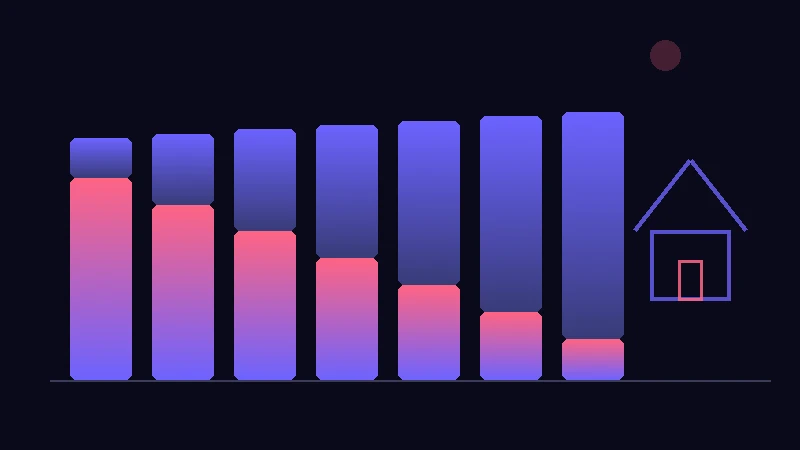
A mortgage payment looks the same every month for years — same dollar amount, same due date — but what that payment actually buys you changes constantly behind the scenes. Understanding how that split works isn't just trivia; it explains why paying off a mortgage feels so slow in the early years, and why a small extra payment now can matter more than a larger one made later.
How Amortization Actually Works
Every fixed-rate mortgage payment splits into two parts: principal (paying down what you borrowed) and interest (the cost of borrowing it). Early in the loan, interest dominates the payment because the outstanding balance is still large — interest is calculated fresh each month based on whatever balance remains. As the balance shrinks, less of each payment goes to interest and more goes to principal, even though the total monthly payment stays exactly the same over the life of a fixed-rate loan.
This structure is called amortization, and it's the reason a 30-year mortgage can feel barely dented after five years of steady, on-time payments. The payment amount never changes; only the ratio of what it's paying for does.
Why Your First Payments Are Mostly Interest
On a $300,000 30-year loan at 6.5%, the very first monthly payment of about $1,896 breaks down to roughly $1,625 in interest and only $271 in principal — interest eats about 86% of that first check. It takes years before the split even approaches 50/50; on this same loan, the balance doesn't cross the halfway point between interest and principal until close to year 18.
This is why paying off a mortgage early, or refinancing after just two or three years, saves relatively little in the way of built-up equity — most of what's been paid so far was the cost of borrowing, not a reduction in what's owed.
The Amortization Formula
The fixed monthly payment on a standard mortgage is calculated using M = P × [r(1+r)^n] / [(1+r)^n − 1], where P is the loan principal, r is the monthly interest rate (the annual rate divided by 12), and n is the total number of payments. Within each month, the interest portion is simply the remaining balance multiplied by the monthly rate, and the principal portion is whatever's left of the fixed payment after that.
This is why lenders can offer a fixed monthly payment even though the interest and principal split changes every single month — the total stays fixed, and only the internal division moves as the balance falls.
What Happens When You Make Extra Payments
Because interest is calculated on the remaining balance, any extra payment applied directly to principal reduces every future month's interest charge, not just that month's. On the $300,000 example above, adding just $200 extra to every monthly payment cuts the loan term from 30 years to roughly 24 years and saves more than $60,000 in total interest — without refinancing or changing the rate.
A single lump-sum extra payment made early in the loan has a larger effect than the same payment made later, simply because it removes interest-bearing balance for more of the loan's remaining months.
Fixed-Rate vs Adjustable-Rate Amortization
A fixed-rate mortgage amortizes on a fully predictable schedule — the payment and the rate never change, only the internal split between principal and interest. An adjustable-rate mortgage (ARM) recalculates the payment, and sometimes re-amortizes the remaining balance, whenever the rate resets, typically after an initial fixed period of 5, 7, or 10 years.
This means an ARM's amortization schedule isn't fully knowable in advance the way a fixed-rate schedule is — borrowers are effectively agreeing to an unknown future payment in exchange for a lower rate during the initial fixed period.
Real Numbers: A 30-Year Loan Broken Down
Take that same $300,000 loan at 6.5% over 30 years. Total payments over the full term add up to about $682,678 — meaning total interest paid is roughly $382,678, more than the original amount borrowed. Switching to a 15-year term at a slightly lower typical rate of 6.0% raises the monthly payment to about $2,532, but cuts total interest paid to roughly $155,838 — less than half of the 30-year total, because the loan spends far less time accumulating interest on a large balance.
Refinancing and How It Resets the Clock
Refinancing replaces the existing loan with a new one — and a new amortization schedule that starts over at the top, front-loaded with interest again. Refinancing to a lower rate can genuinely save money, but stretching the loan back out to a fresh 30-year term after already paying down several years of a previous mortgage can increase total interest paid even at a lower rate, because the borrower resets back into the interest-heavy early years.
Comparing the new loan's total interest to the interest remaining on the current loan — not just the two rates side by side — is the only reliable way to know whether a refinance is actually a net gain.
Common Amortization Mistakes to Avoid
The most common mistake is assuming a lower monthly payment automatically means a better deal — a longer term almost always lowers the payment while raising total interest paid over the life of the loan. Another is not confirming that extra payments are actually applied to principal rather than held as a credit toward next month's payment, which some lenders default to unless a borrower specifically requests otherwise.
A third is ignoring the amortization schedule entirely and only glancing at the balance on an annual statement, which hides how much of the past year's payments actually went toward reducing debt versus simply covering interest.