Should You Rent or Buy? The Complete Financial Analysis
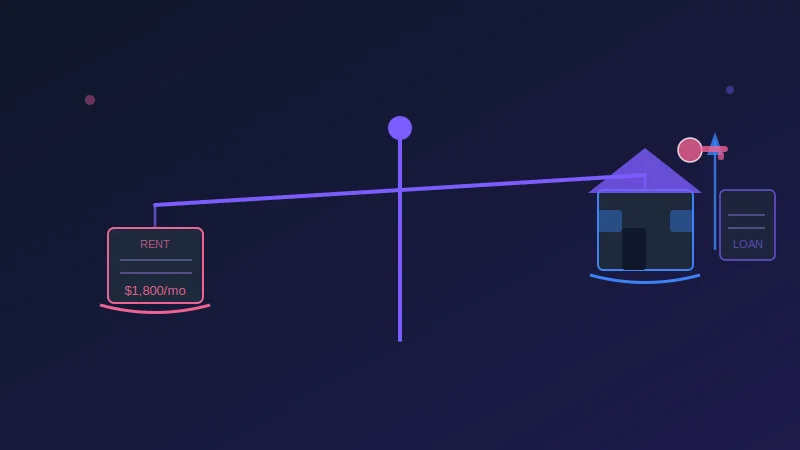
The rent versus buy decision is probably the single biggest financial choice most people ever face. It's not purely a finance question — it pulls in lifestyle preferences, career plans, family circumstances, and how you think about long-term wealth all at once. There's no universally correct answer. But there is a framework for thinking through it properly, rather than just defaulting to whatever culture, family, or conventional wisdom tells you.
The True Cost of Buying: More Than the Mortgage
Most people look at the mortgage payment and call it the cost of ownership. The actual number is substantially higher, and the gap between them is where a lot of purchase decisions quietly go wrong. Property taxes: 0.5–2.5% of home value annually depending on location. Home insurance: PKR 20,000–60,000 per year for typical urban properties. Maintenance and repairs: budget 1–2% of home value annually — a PKR 10,000,000 home requires PKR 100,000–200,000 reserved per year, and years with major repairs (roof, plumbing, electrical) can cost far more. Society maintenance fees: PKR 3,000–10,000 per month in most gated communities. Mortgage insurance if your down payment is below 20%.
Transaction costs at purchase: stamp duty (typically 2–3% of property value in Pakistan), registration fees (1–2%), real estate agent commission (1–2%), legal and documentation fees. On a PKR 10,000,000 property, those upfront costs can easily total PKR 600,000 to 800,000 before you've moved in a single piece of furniture. When you eventually sell, add agent commissions and potential capital gains taxes on the other side. These transaction costs mean the property needs to appreciate quite significantly just to break even — before ownership even starts to look better than renting and investing the difference.
The True Cost of Renting: Not Throwing Money Away
"Throwing money away on rent" is one of the most misleading phrases in personal finance. Rent buys you something real: a place to live, freedom from maintenance headaches, and the flexibility to move when opportunity arises. The honest comparison isn't "rent that disappears versus mortgage that builds equity." It's total cost of ownership versus total cost of renting while systematically investing the money you'd otherwise have tied up in a property.
The question renters need to answer honestly: what are you actually doing with the money you'd otherwise have put into a down payment, and with whatever you're saving each month versus the cost of owning? A PKR 2,000,000 down payment invested in National Savings Certificates at 18% annual return becomes approximately PKR 9,600,000 in ten years. Invested in a diversified equity mutual fund at 12–15% historical annual return, it becomes PKR 6,200,000–8,100,000. If the renter also systematically saves and invests the monthly difference between rent and the full cost of homeownership, the wealth accumulation can rival or exceed the homeowner's equity position in many market conditions — particularly when property prices are high relative to rental income.
-->The Price-to-Rent Ratio: A Practical Starting Point
The price-to-rent ratio — home purchase price divided by annual rent for a comparable property — provides a useful first-pass analysis. Under 15: buying generally makes financial sense assuming sufficient holding period. 15–20: a grey zone where the decision depends on holding period, market dynamics, and personal financial situation. Over 20: renting is often financially superior because you can live in equivalent housing for significantly less than the carrying cost of ownership.
Example: A PKR 12,000,000 property with comparable monthly rent of PKR 35,000 (PKR 420,000 annually). Ratio = 12,000,000 ÷ 420,000 = 28.6. This is high — the property trades at nearly 29 years of rent value. At this ratio, the annual total cost of ownership (mortgage interest, maintenance, property taxes, opportunity cost of down payment) significantly exceeds annual rent. Unless you expect rapid sustained price appreciation or plan to hold for an exceptionally long period, renting is financially compelling at this ratio. Many premium Pakistani urban areas — DHA Lahore, Clifton Karachi, F-sector Islamabad — currently trade at price-to-rent ratios in the 25–35 range, suggesting the financial case for buying is primarily a bet on continued capital appreciation rather than current yield economics.
Transaction Costs: The Factor That Changes the Timeline
In Pakistan, property transaction costs are significant and frequently underestimated. Stamp duty (3% of declared value), registration fee (1–2%), agent commission on both sides (1–2% each), legal documentation, and transfer taxes collectively amount to PKR 700,000–900,000 on a PKR 10,000,000 property. Selling later adds another PKR 300,000–500,000 in selling costs. These transaction costs mean the property must appreciate by PKR 1,000,000–1,400,000 (10–14%) before you even break even on the transaction costs alone, before any comparison to renting becomes favorable.
This has a direct implication for holding period: for short holding periods of 2–3 years, renting often wins on transaction costs alone even in appreciating markets. The break-even holding period — the time you must stay before buying becomes financially superior to renting — is typically 5–7 years in moderate markets and can extend to 10+ years in high price-to-rent markets like premium Pakistani urban locations. If your career flexibility, family situation, or personal uncertainty makes relocation within 5 years plausible, renting deserves serious consideration regardless of other factors.
The Down Payment Opportunity Cost
The opportunity cost of the down payment is the most important variable that typical rent-versus-buy analysis ignores. A 20% down payment on a PKR 10,000,000 home is PKR 2,000,000. At Pakistan's current National Savings Certificate rates of 14–18%, that capital earns PKR 280,000–360,000 annually in guaranteed, government-backed returns. Over 10 years at 16%, compounding, that PKR 2,000,000 grows to approximately PKR 8,900,000. If instead deployed in a diversified equity mutual fund at 12% historical return, it becomes approximately PKR 6,200,000 — still more than three times the original amount.
The comparison is not rent payment versus mortgage payment — it is total homeownership costs versus renting-plus-investing the financial difference. In periods of high National Savings rates, the financial opportunity cost of a large down payment deployed in property rather than in NSCs is genuinely substantial and worth quantifying explicitly before committing to purchase. Many Pakistani families who could have earned 21% in NSCs during 2023–2024 instead tied capital in property that appreciated 8–12% over the same period — a material real-terms difference over multi-year compounding.
Pakistan-Specific Property Market Realities
Pakistan's property market has structural characteristics that make the rent-versus-buy calculation different from developed country models in important ways. Title and documentation quality remain problematic across a significant portion of the urban property market — properties with unclear title, encumbrance issues, or incomplete registration paperwork create legal risk for buyers that renters do not face. Due diligence on title clarity, encumbrance certificates, and property tax records requires professional legal assistance and meaningful time investment before any purchase commitment. Skipping this due diligence is one of the most common and costly mistakes Pakistani property buyers make.
Pakistan's property market has historically been a store of value during inflationary periods, with real estate in major urban centres appreciating faster than CPI inflation over multi-decade periods. DHA Lahore, Clifton and Defence Karachi, and Islamabad's F and G sectors have delivered substantial long-run capital appreciation. However, these gains are concentrated in specific localities and quality tiers — secondary cities and suburban extensions show much more variable outcomes. The strong historical performance of premium locations is not guaranteed to continue, particularly as the sector faces ongoing regulatory changes related to anti-money laundering compliance under FATF requirements that have increased documentation burdens and affected informal investment flows that previously supported demand.
Rental Yield Benchmarks and Investment Property Logic
Gross rental yield — annual rent as a percentage of purchase price — is a useful metric for evaluating property as an investment. Typical gross rental yields in Pakistani cities: 3–5% in premium locations (DHA Lahore, F-6/F-7 Islamabad, Clifton Karachi) and 5–8% in middle-income areas. Net yields after maintenance, agent fees, vacancy periods, and any applicable taxes are typically 1–2% lower than gross yield. These net yields compare unfavorably to National Savings instruments currently offering 14–18%, meaning property ownership in premium areas is primarily a bet on capital appreciation rather than a yield-generating investment.
For buyers purchasing specifically as a rental income investment rather than for personal use, location selection with higher gross yield is financially more important than prestige of address. A property yielding 7% gross in a stable secondary location produces more rental income per rupee invested than a property yielding 4% in a premium location, even if the premium property has stronger capital appreciation prospects. Only combining both strong yield and strong appreciation potential justifies property as an investment in an environment where comparable-risk government securities offer 14–18%.
Pakistani Cultural Context: The Values Beyond Finance
In Pakistani culture, property ownership carries social significance beyond financial calculation. A family home represents security, stability, inheritance for children, and social standing that renting simply does not convey in the same cultural context. These values are genuine and legitimate — they represent real utility that belongs in the analysis, not dismissed as irrational sentiment unworthy of serious consideration. A financial analysis that concludes renting is optimal while ignoring that the family will feel perpetually insecure, unable to renovate and personalize, or socially uncomfortable is incomplete — life is not a spreadsheet, and the cultural and psychological dimensions of where you live are part of the full cost-benefit picture.
The right purpose of financial analysis in the rent-versus-buy decision is not to override personal values with arithmetic but to ensure the decision is made with full awareness of the financial trade-offs — not on the basis of unchallenged cultural assumptions that buying is always superior regardless of specific circumstances. For Pakistani families combining long-term stability, predictable income, genuinely affordable down payment, and strong personal preference for ownership — buying often makes both financial and personal sense. For those with high career mobility needs, access to attractive NSC returns on the down payment capital, or genuine 5-year planning uncertainty — renting and investing the difference is worth serious consideration rather than automatic dismissal as financially inferior.
Additional context — Property transaction costs are easy to underestimate in a rent-vs-buy comparison: between closing costs, agent commissions, and moving expenses, buying and then selling a home within just a few years can consume roughly 8–10% of the property's value in transaction costs alone, before any price appreciation or decline is even factored in.
Additional context — Mortgage interest deductibility, where available, only provides a tax benefit if total itemized deductions exceed the standard deduction — a threshold that rose significantly in the US after 2017 tax reform, meaning many homeowners who previously benefited from the deduction no longer itemize at all.