Understanding EMI: How Your Loan Repayment Actually Works
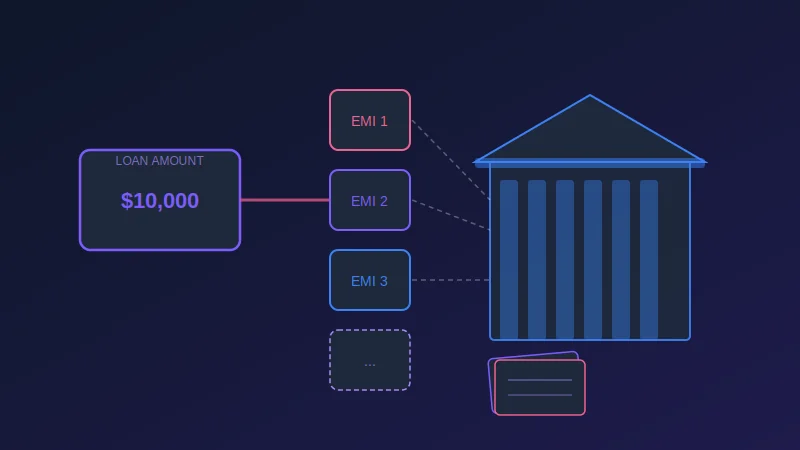
Most people who take a loan know their monthly EMI figure. Far fewer understand what that money is actually doing each month. Why does the bank seem to barely touch your principal in the early years? How can a small extra payment each month save you lakhs over the life of the loan? Here's the full picture of how loan amortization actually works.
What Is EMI?
EMI stands for Equated Monthly Instalment — the fixed monthly payment that repays your loan over its full term. Every EMI is made up of two parts: principal (reducing the actual debt) and interest (the cost of borrowing). The total amount stays the same every month, but the split between those two components shifts dramatically over time. In the early months, you're mostly paying interest. In the final years, you're mostly repaying principal. Most borrowers are genuinely surprised when they first see this laid out clearly.
The EMI formula: EMI = P × r × (1+r)^n ÷ ((1+r)^n − 1), where P is the principal, r is the monthly interest rate (annual rate divided by 12), and n is the total number of monthly instalments. A PKR 3,000,000 car loan at 20% annual interest for 5 years: r = 0.01667, n = 60, EMI ≈ PKR 79,425 per month. Total paid over 5 years: PKR 4,765,500. Total interest paid: PKR 1,765,500 — you pay 58.8% of the original loan amount in interest charges alone, on top of repaying the principal.
Why Early Payments Are Mostly Interest
On a PKR 5,000,000 home loan at 18% annual interest over 20 years, your EMI is roughly PKR 80,000. In your very first payment, PKR 75,000 of that — nearly 94% — goes to interest. Only PKR 5,000 actually reduces your debt. By month 120, the split has shifted to about 70% interest and 30% principal. It's only in the final years that the majority of each payment is actually paying down what you owe. The mathematical reason: interest is calculated on the outstanding balance, which starts at the full loan amount and reduces only very slowly in early years.
This structure is why making extra payments in the first few years of a loan produces dramatically larger savings than making the same extra payments in later years. An extra PKR 10,000 applied to principal in month 3 saves interest on that amount for the remaining 237 months. The same PKR 10,000 in month 200 saves interest for only 40 months. Time compounds both ways — interest charges and interest savings both compound over the remaining loan period.
-->The Total Interest Paid: Calculate It Before You Sign
On a PKR 5,000,000 home loan at 18% for 20 years: total amount paid is approximately PKR 19,200,000. Total interest paid is approximately PKR 14,200,000 — nearly three times the original loan amount. This is not deception — it is mathematically how amortization works at high interest rates over long tenures. The longer the tenure, the lower the monthly EMI, but the higher the total interest cost. A 30-year tenure on the same loan would have a lower monthly payment but even more total interest across 360 months of compound accumulation.
Running this calculation before signing any loan agreement reveals the true cost immediately. Many borrowers focus exclusively on the monthly payment without computing the total amount paid — a framing that lenders benefit from because low monthly payments make expensive loans feel affordable. Always calculate and understand the total repayment amount, then decide whether the asset justifies that total cost, not just whether the monthly payment fits your current budget. PKR 80,000 per month sounds manageable. PKR 19,200,000 total sounds very different.
How to Save Significantly With Extra Payments
Making even small additional principal payments dramatically reduces total interest and loan tenure. On the PKR 5,000,000 example at 18% for 20 years: paying PKR 5,000 extra per month saves approximately PKR 2.5 million in interest and closes the loan roughly 4.5 years early. Paying one additional full EMI per year saves approximately PKR 1.5 million and closes the loan 2.5 years early. A single lump-sum prepayment of PKR 200,000 applied in year 2 saves approximately PKR 800,000 in future interest — a 4x return on the extra payment in interest savings alone.
Critical detail: specify that any extra payment should reduce principal, not future instalments. Some Pakistani banks default to applying overpayments toward future EMIs, which has minimal interest-saving benefit — you simply skip future payments rather than reducing the outstanding balance and its associated interest charges. Confirm explicitly with your lender that extra payments will be applied directly to outstanding principal. This single administrative clarification can mean the difference between significant interest savings and no savings at all from the same extra payment amount.
Fixed vs Floating Rate EMI
A fixed-rate loan means your EMI stays identical for the entire tenure regardless of market rate movements. Predictable, but typically priced 0.5–1% higher than floating rates at signing. This premium buys certainty — you know your exact obligation for every month of the loan. Appropriate if you expect rates to rise, your income is fixed, or budget predictability is important to your financial planning.
A floating-rate loan means your EMI adjusts when the reference rate changes. In Pakistan, loans are typically priced at KIBOR (Karachi Interbank Offered Rate) plus a fixed spread of 2–5%. When the State Bank of Pakistan raises the policy rate — as it did through 2022–2024, reaching 22% — your EMI increases. When rates fall, your EMI decreases or tenure shortens. Over 20-year historical periods, floating-rate loans in Pakistan have typically been cheaper — but they require budgeting for worst-case rate increases. A household committing 40% of income to EMI has no buffer when floating rates rise 3–4 percentage points over 18 months, as they did in 2022–2023.
Prepayment Penalties: Read Before You Pay Extra
Some Pakistani bank loans include prepayment penalties of 1–3% of the outstanding balance at the time of early payment. Read the loan agreement carefully before making any lump-sum prepayments, as the penalty can partially or fully offset the interest savings you intended to realize. If your loan documents specify a 2% prepayment penalty and you plan to prepay PKR 500,000, the penalty is PKR 10,000 — worth calculating against the projected interest savings before deciding whether and when to prepay.
Prepayment penalties typically apply during an initial lock-in period of 1–3 years and reduce or disappear afterward. If your loan has a lock-in period, focus on making regular extra payments within the terms that do not trigger penalties during the lock-in, then make larger lump-sum prepayments once the penalty period expires. Knowing these terms before signing — not after you have received a bonus and want to reduce your debt — prevents unpleasant surprises and allows for optimal financial planning.
Loan Comparison: APR, Not Advertised Rate
When comparing loans across banks, focus on the Annual Percentage Rate (APR) rather than the nominal rate. Processing fees, insurance requirements, documentation charges, and fee structures can make a lower advertised rate actually more expensive in total terms than a slightly higher-rate loan with no fees. The SBP requires Pakistani banks to disclose APR — use this figure for accurate comparisons. A loan advertised at 18% with PKR 50,000 in processing fees on a PKR 2,000,000 loan has an effective cost higher than a loan advertised at 18.5% with no fees, depending on tenure.
Shopping your loan across competing banks every 3–5 years — particularly after significant interest rate movements in your favor — is standard practice for financially aware borrowers. Banks value existing customers less than they value new customer acquisition, meaning competitor offers are sometimes genuinely better than loyalty discounts from your current lender. Refinancing a high-rate loan at a lower rate can save significant total interest, though the savings must be weighed against refinancing transaction costs including any prepayment penalties on the existing loan and processing fees on the new one. Run the full numbers before refinancing, not just the rate comparison.
Common EMI Mistakes Pakistani Borrowers Make
The most common mistake: borrowing based on what the bank will approve rather than what your income can comfortably sustain. Pakistani banks typically approve loans up to 40–50% of declared income in total EMI obligations — but financial resilience and comfort are significantly better when total EMI stays below 30% of take-home pay. The remaining 10–20% difference provides the buffer for emergency expenses, income disruption, medical costs, and interest rate increases on floating-rate loans.
The second common mistake is choosing tenure to minimize monthly payment without calculating total interest cost. A 7-year car loan has a lower monthly payment than a 3-year loan for the same car — but the total interest paid on a 7-year term can be two to three times more. The car loses value while the loan remains; at year 7 you have paid far more than the vehicle's market value. For depreciating assets like vehicles, shorter tenures are almost always financially superior even when the monthly payment feels higher. Reserve longer tenures for appreciating assets like property where the total cost must be weighed against expected price appreciation and the housing utility value over the holding period.
Additional context — The exact same advertised interest rate can represent different real costs depending on the compounding frequency stated in the loan contract — a loan advertised at "12% annual" with monthly compounding carries a slightly higher effective annual rate than one with true annual compounding, a distinction few borrowers check before signing.
Additional context — Some lenders calculate EMI using a flat interest rate rather than a reducing balance — charging interest on the full original loan amount for the entire term instead of on the shrinking balance — which can make a loan advertised at a lower flat rate actually cost more in total interest than a higher reducing-balance rate.